
Hybrid Automotive Service

Hybrid Battery Replacement in Australia: What to Watch Out For in 2026

If you drive a hybrid in Australia, 2026 is a year to pay close attention to your battery’s health. With thousands of Toyota and Lexus hybrids now reaching the 8-12 year mark, many owners are facing their first battery replacement. Here’s what you need to know to make smart decisions and avoid costly surprises. Signs Your Hybrid Battery May Be Failing Hybrid batteries don’t fail overnight, they give you warning signs. Watch out for these common symptoms: Reduced fuel economy: If your fuel efficiency has dropped noticeably without explanation, your battery may no longer be holding a charge efficiently. Dashboard warning lights: The “Check Hybrid System” light or battery warning indicator should never be ignored. Sluggish acceleration: A weak battery can’t deliver power when you need it, especially when accelerating from a stop. Erratic charge display: If your battery meter jumps from full to empty rapidly, the cells may be failing. Loud cooling fan: A constantly running or unusually loud fan at the rear of your car indicates the battery is overheating. Difficulty starting: Unlike regular cars, hybrids use the high-voltage battery to start, so starting issues often point to battery trouble. If you notice more than one of these symptoms, it’s time to get a professional battery health check. What Australian Hybrid Owners Should Watch in 2026 Replacement Costs Hybrid battery replacement costs in Australia typically range from $1,500 to $4,500 AUD, depending on your vehicle model and the type of battery you choose. For example, a Toyota hybrid battery replacement for models like the Prius or Camry generally falls between $1,500 and $3,800 AUD, while Lexus hybrid battery replacement for models such as the RX450h or CT200h may cost slightly more due to larger battery packs. You’ll typically have three options: rebuilt batteries (most affordable), aftermarket new batteries (mid-range), or OEM genuine batteries (premium but longest-lasting). Battery Lifespan Expectations Most hybrid batteries last 8–12 years or 150,000-200,000 kilometres. If your vehicle is approaching these milestones, it’s wise to have the battery tested even if you haven’t noticed problems yet. Early detection can save you from being stranded. Availability and Wait Times With growing demand for hybrid battery replacements across Australia, some models may experience longer wait times for parts. Planning ahead-especially for popular vehicles like the Prius and Camry-can help you avoid extended downtime. Technology and Standards 2026 brings stricter regulations around battery safety and recycling in Australia. Ensure your replacement provider uses batteries that meet current Australian standards and offers proper warranty coverage, typically 2-3 years for quality replacements. Why Choosing the Right Replacement Matters Not all hybrid batteries are equal. A poor-quality replacement might save you money upfront but could fail within a year or two, leaving you back where you started. Here’s what to look for: Warranty: Reputable providers offer at least a 2-year warranty on replacement batteries. Accredited installers: Hybrid battery work requires specialised knowledge, always use qualified technicians. Battery testing: Good providers will perform a full diagnostic before recommending replacement. Multiple options: The best specialists offer rebuilt, aftermarket, and OEM choices to suit your budget. Replacing your hybrid battery with the right product and installer extends your vehicle’s life, restores fuel efficiency, and protects your investment. Ready to Get Your Hybrid Battery Checked? If you’re experiencing any warning signs or your hybrid is approaching the 8-year mark, don’t wait until you’re stranded. Getting a professional battery health assessment can give you peace of mind and help you plan for replacement on your terms, not in an emergency. Contact our hybrid battery specialists today for expert advice, free diagnostics, and competitive pricing on Toyota and Lexus hybrid battery replacements across Australia.

Reset the “Check Hybrid System” Warning on Lexus CT200h
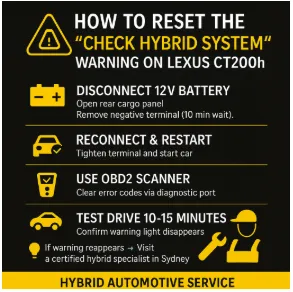
If your Lexus CT200h dashboard suddenly flashes the message “Check Hybrid System”, it means your vehicle’s onboard diagnostics have detected a fault in one or more hybrid components. This warning isn’t always catastrophic, but it should never be ignored. Your CT200h’s hybrid system consists of several key parts — including the hybrid battery pack, inverter, ECU (engine control unit), and 12V battery. When any of these communicate incorrectly or show irregular voltage levels, the system triggers the warning light. In some cases, this message appears after routine maintenance or a weak battery. However, it may also indicate deeper issues such as battery imbalance, inverter overheating, or sensor malfunctions. Common Causes of the “Check Hybrid System” Light Here are the most frequent reasons your Lexus CT200h might display the warning:  1. Weak or Failing Hybrid Battery A Deteriorating high-voltage Hybrid Battery can cause inconsistent power output, triggering the warning. This is common in CT200h models older than 8–10 years. 2. Faulty Inverter or ECU Communication Error The inverter converts DC power from the Hybrid Battery into AC power for the electric motor. A fault or data error in the inverter circuit can easily cause the system alert. 3. Loose or Corroded 12V Battery Terminals Corroded or weak connections on the 12V battery can disrupt ECU communication, resulting in false system errors.  4. Hybrid Cooling Fan Obstruction Dust or debris in the hybrid battery fan can cause overheating, which may lead to system shutdown for protection.  5. Software or Sensor Glitch Sometimes the warning appears after a jump start, recent service, or when the vehicle’s software detects an inconsistent sensor reading. Safety Precautions Before Resetting Before attempting a reset, follow these safety steps to prevent damage or injury: Park your CT200h on level ground and engage the parking brake. Turn off the ignition completely. Never touch orange high-voltage cables unless you’re a trained technician. Use insulated gloves when inspecting battery terminals. Make sure you have proper lighting and avoid metal tools that could cause sparks. Step-by-Step Guide: How to Reset the “Check Hybrid System” on Lexus CT200h If the issue is minor (for example, after a jump start or brief voltage drop), you can try resetting the system safely. Step 1: Disconnect the 12V Battery Locate the 12V battery in the rear cargo area. Use a 10mm wrench to remove the negative (-) terminal. Leave it disconnected for 5–10 minutes to clear temporary error codes. Step 2: Reconnect the Battery Reattach the terminal securely. Turn on the vehicle and check if the message disappears. Step 3: Use an OBD2 Scanner (Optional Advanced Reset) Plug a compatible OBD2 scanner into the diagnostic port under the dashboard. Access “Hybrid Control” or “ECU” modules. Select “Clear Fault Codes” and restart the vehicle. Step 4: Perform a Test Drive Drive the car for 10–15 minutes under normal conditions. If the light remains off, the reset was successful. If it reappears, the fault may require professional attention. When the Warning Doesn’t Go Away If the warning light returns after a reset, it usually means there’s a deeper fault in the hybrid system. This can include: A weak or imbalanced CT200H Hybrid Battery module Cooling fan malfunction or blockage Inverter or ECU failure Battery temperature sensor fault Continuing to drive with the light on can cause your CT200h to enter limp mode, reducing performance and fuel efficiency. At this point, you should avoid DIY attempts and seek help from a qualified hybrid specialist with Toyota Techstream diagnostics. Preventive Maintenance Tips You can avoid hybrid system warnings with regular care: Schedule a hybrid battery health check every 6 months. Keep the battery cooling fan and ducts clean. Don’t leave the car unused for long periods — the hybrid battery needs regular charging cycles. Replace the 12V auxiliary battery every 3–4 years. Use genuine Toyota parts and fluids during service. Professional Lexus CT200h Hybrid System Repair in Sydney If your Lexus CT200h “Check Hybrid System” light stays on even after a reset, it’s time for a professional inspection. At Hybrid Automotive Service in Belmore, Sydney, we specialize in diagnosing and repairing Lexus and Toyota hybrid systems. ✅ Same-day diagnostic & reset service ✅ 24-month / 100,000 km hybrid battery warranty ✅ Certified hybrid technicians with advanced tools ✅ Genuine Toyota & Lexus compatible parts Visit our workshop or call us today to schedule a hybrid system diagnostic test. Website: www.hybridautomotives.com.au Address: 668 Canterbury Rd, Belmore NSW 2192  

Top 7 Common Toyota Estima Hybrid Problems (And How to Fix Them)

Toyota Estima Hybrid Common Problems

The Toyota Estima Hybrid is a reliable and family-friendly MPV that offers excellent fuel economy and a smooth driving experience. However, like all hybrid vehicles, it is not without its share of issues—especially as the vehicle ages. Understanding these common problems can help you take proactive steps to maintain your Estima’s performance and avoid costly repairs. At Hybrid Automotive Service, we specialize in diagnosing and repairing hybrid vehicles like the Toyota Estima. In this guide, we’ll walk you through the 7 Most Common Toyota Estima Hybrid Problems and provide expert advice on how to fix or prevent them. 1. Hybrid Battery Degradation Issue: One of the most reported issues with the Toyota Estima Hybrid is battery degradation. Over time, the high-voltage hybrid battery loses its capacity, resulting in reduced fuel efficiency, weak acceleration, or even triggering the “Check Hybrid System” warning. Fix: At Hybrid Automotive Service, we offer three hybrid battery replacement options for the Estima: brand-new aftermarket, OEM (Toyota original), and high-quality rebuilt batteries. All of our replacements come with a comprehensive warranty of up to 3 years or 100,000 km. Prevention Tip: Regular hybrid battery health checks every 6–12 months can help monitor performance and catch early signs of battery deterioration. 2. Inverter Failure Issue: The inverter is a crucial part of the hybrid system that converts DC from the battery to AC for the electric motor. Faulty inverters can cause stalling, warning lights, or complete vehicle shutdowns. Fix: Inverter repairs often require expert diagnostics and replacement with genuine or high-quality parts. At Hybrid Automotive Service, we use OEM diagnostic tools to pinpoint inverter issues accurately and perform professional repairs. Tip: Ensure the inverter cooling system is functioning properly to avoid overheating, a common cause of inverter failure. 3. Electric Water Pump Malfunction Issue: The electric water pump in hybrid vehicles cools the inverter and engine components. When it fails, it can cause overheating and reduced performance, and it often triggers dashboard warnings. Fix: A faulty electric water pump should be replaced immediately. We stock and install reliable aftermarket and OEM water pumps that are compatible with the Toyota Estima Hybrid. Warning Sign: Listen for unusual noises or vibrations from the engine bay—these may indicate a failing pump. 4. ABS Pump Failure Issue: The Estima’s ABS pump and actuator are known to develop issues over time, leading to a stiff brake pedal, ABS warning light, and decreased braking efficiency. Fix: We provide ABS pump repair and replacement services with quality-tested units. In some cases, the issue can be resolved with reprogramming or brake bleeding; in others, a full replacement is necessary. Safety Note: Don’t ignore braking issues—it’s vital to address them immediately for the safety of you and your passengers. 5. Faulty Hybrid Cooling Fan Issue: The battery cooling fan prevents the hybrid battery from overheating. If clogged with dust or debris, it can cause the battery to overheat and trigger warning messages. Fix: Our technicians at Hybrid Automotive Service offer hybrid cooling fan cleaning and replacement services. Keeping the fan clean significantly improves battery performance and lifespan. DIY Tip: Avoid placing items in the rear trunk area that could block the airflow to the cooling fan intake. 6. Transmission Shudder or Hesitation Issue: Some Estima Hybrid owners report a shudder or hesitation when accelerating, often due to issues in the eCVT (electronic continuously variable transmission) or degraded transmission fluid. Fix: We recommend a complete transmission fluid flush and inspection. If the issue persists, further diagnostics may reveal the need for transmission component repair or replacement. Maintenance Tip: Change hybrid transmission fluid every 40,000–60,000 km to prevent long-term wear. 7. “Check Hybrid System” Warning Issue: This catch-all warning light can indicate a range of issues, from battery faults to sensor malfunctions. Fix: A professional scan with hybrid-specific diagnostic tools is essential to determine the root cause. At Hybrid Automotive Service, we offer free car scanning with hybrid battery replacement services. Don’t Guess: Generic OBD-II readers often miss hybrid-specific trouble codes. Always use a certified hybrid specialist for accurate diagnosis. Why Choose Hybrid Automotive Service? With years of experience and a dedicated team of hybrid specialists, Hybrid Automotive Service is the trusted name for Toyota Estima Hybrid repairs in Sydney and surrounding areas. We offer: Free hybrid battery diagnostics Multiple replacement options (OEM, rebuilt, aftermarket) Transparent pricing 2 Year/100,000 km warranty Mobile installation Available Sydney & Nearby Area  

Lexus CT 200h Common Problems: What to Watch Out For
problems

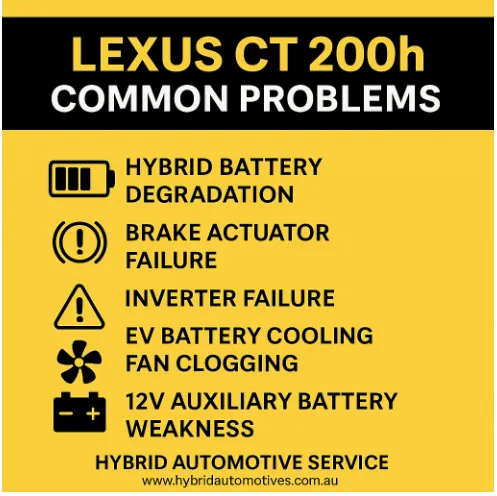
The Lexus CT 200h is a stylish, fuel-efficient hybrid hatchback loved for its smooth driving experience and eco-friendliness. However, like all hybrid vehicles, the CT 200h is not immune to mechanical and electrical issues, especially as it ages or racks up mileage. At Hybrid Automotive Service, we’ve worked on hundreds of Lexus hybrids across Sydney and have seen a consistent pattern of common issues owners face. 1.  Hybrid Battery Degradation Problem: One of the most frequent issues in the CT 200h, especially in vehicles over 8–10 years old or with 150,000+ kilometers, is hybrid battery failure. Symptoms: Drop in fuel economy Warning lights (Check Hybrid System) Sluggish acceleration Fan noise from the rear (battery cooling system overworking) Fix: At Hybrid Automotive Service, we offer three options For Lexus CT200H Hybrid Battery: OEM Hybrid Battery Rebuilt Hybrid Battery (with new modules) Aftermarket Hybrid Battery (affordable & warranty-backed) We also provide mobile battery replacement services across Sydney for your convenience. 2.  Brake Actuator & ABS Pump Failure Problem: Another common fault is with the brake actuator (ABS pump) system. This component controls braking pressure and is crucial for regenerative braking in hybrids. Symptoms: Loud clicking or buzzing sound after starting the car Brake warning light or ABS light on the dashboard “Check VSC System” warning Spongy or inconsistent brake pedal Fix: This is a critical safety component. At Hybrid Automotive Service, we specialize in ABS actuator repair and replacement for Lexus hybrids using genuine parts. 3.  Inverter Failure Problem: The inverter/converter unit regulates electricity between the hybrid battery and electric motor. It can fail due to overheating or wear over time. Symptoms: Vehicle stalls suddenly “Check Hybrid System” or red triangle warning Difficulty starting the car Engine shuts off unexpectedly Fix: The inverter is a complex component. We recommend immediate diagnosis. We perform inverter replacements using OEM or tested refurbished units depending on your budget. 4. EV Battery Cooling Fan Clogging Problem: The battery cooling fan can accumulate dust, hair, and debris over time, especially if pets frequently ride in the car. Symptoms: Increased noise from the rear fan Overheating hybrid battery Hybrid system errors Fix: Our technicians perform regular battery fan cleaning during routine inspections or battery replacements. This simple maintenance can help prolong battery life. 5. 12V Auxiliary Battery Weakness Problem: The small 12V auxiliary battery powers startup systems and accessories. It often gets overlooked in hybrids. Symptoms: Difficulty starting the car Dim dashboard lights Frequent need for jump-starts Fix: We provide affordable 12V battery testing and replacement at our Belmore workshop or via mobile service. 6.  HVAC & Air Conditioning Issues Problem: Owners have reported issues with climate control systems, often linked to faulty sensors or AC inverter issues. Symptoms: AC blowing hot air Climate control not responding Irregular fan speeds Fix: At Hybrid Automotive Service, we inspect hybrid climate systems and replace faulty inverters or sensors to restore comfort.   7. Lexus CT 200h Reliability Issues Problem:While the CT 200h enjoys a reputation for quality and hybrid-efficiency, its reliability can be impacted if maintenance is neglected, mileage is high, or it has been used in demanding conditions. Issues such as excessive wear on hybrid components, frequent warning lights, or repeated minor failures can signal underlying reliability concerns.Common Scenarios: A vehicle with high mileage (150,000 km+) showing multiple warning lights or degraded performance Hybrids where cooling systems, battery maintenance or brake systems have been deferred Cars used heavily in stop/start traffic, short trips (which may not allow full hybrid cycle optimization) or in harsh climates Why this matters:Reliability doesn’t just mean “won’t break down” — it means consistent performance, minimal unexpected repairs and predictable maintenance costs. In the case of the CT 200h, a well-maintained car will live up to its promise of efficiency and quality; one that has missed key maintenance may see increasing costs and reduced confidence. Advice: Review service history: has the hybrid battery been tested, the cooling fan cleaned, brake actuator inspected? Look for repeated fault codes: “Check Hybrid System”, ABS/VSC warnings, or inverter trouble signs. Consider pre-purchase inspection by a hybrid specialist (such as Hybrid Automotive Service) to assess condition and reliability projections. Keep up scheduled maintenance (hybrid battery health checks, cooling fan cleaning, brakes/ABS system inspections) to preserve reliability.By proactively managing maintenance and addressing warning signs early, you can help ensure your CT 200h remains a reliable, enjoyable hybrid for years to come. Preventative Tips from Hybrid Automotive Service To avoid expensive repairs, we recommend: Servicing your CT 200h every 10,000–15,000 KM Regular hybrid battery diagnostics Cleaning the battery fan every 12 months Checking 12V battery and brake fluid annually Using qualified hybrid specialists only Book a Lexus CT 200h Inspection Today At Hybrid Automotive Service, we specialize in Toyota and Lexus hybrids. Whether you’re facing battery problems, brake issues, or electrical faults, we’re here to help. Our services are available at our Belmore workshop or via mobile units across Sydney, Parramatta, Bankstown, and beyond. 📞 Call Us: +61 493 688 444 🌐 Visit: www.hybridautomotives.com.au 📍 Location: Belmore, NSW 🛠️ Service: Diagnosis, repair, and battery replacement for Lexus CT 200h

How to Identify and Fix the “Check Hybrid System” Warning in Toyota Aqua

If you drive a Toyota Aqua, you may have seen the dreaded “Check Hybrid System” warning appear on your dashboard. This alert can be concerning, especially if it happens while driving. In this article, we’ll explain what this warning means, the common causes, how to identify the problem, and the best solutions available. Identify and Fix the “Check Hybrid System” Warning in Toyota Aqua At Hybrid Automotive Service, we specialize in Toyota and Lexus hybrid battery replacement across Sydney and NSW. Here’s everything you need to know. What Does the “Check Hybrid System” Warning Mean? The “Check Hybrid System” warning in a Toyota Aqua indicates that something is wrong with the hybrid system, which includes the high-voltage battery, inverter, sensors, and the ECU (engine control unit). When this light comes on, the car may switch to limp mode, reduce power output, or in some cases, stop running. Ignoring the warning can lead to more expensive repairs down the road. Common Causes of the Warning in Toyota Aqua Several issues can trigger the warning light, but the most frequent ones include: 1. Weak or Failing Hybrid Battery A deteriorating hybrid battery is the number one reason for this error. The Toyota Aqua uses a nickel-metal hydride (Ni-MH) pack that typically lasts 7–10 years. 2. Faulty Inverter or Converter The inverter manages the flow of power between the battery and electric motor. If it overheats or fails, the hybrid system will show an error. 3. Cooling Fan Blockage or Malfunction Blocked air vents or a faulty cooling fan can cause the battery to overheat, triggering the warning. 4. Low 12V Auxiliary Battery Even though the Aqua is a hybrid, the 12V battery plays an important role. If it is weak, the system may malfunction. 5. Sensor or ECU Faults A failed sensor or corrupted ECU data can also result in the error message. How to Identify the Issue (Step-by-Step Diagnosis) If you see the warning, here’s how you can begin diagnosing: Check with an OBD-II Scanner – Plug in a scanner to read hybrid system error codes. Inspect the 12V Battery – Test its voltage and replace it if weak. Listen for Cooling Fan Noise – If the fan isn’t running properly, airflow may be blocked. Look for Performance Drops – Lower fuel economy or reduced acceleration can signal battery degradation. Consult a Hybrid Specialist – Professional scans can pinpoint inverter, ECU, or battery faults. Fixing the “Check Hybrid System” Warning Depending on the diagnosis, here are the possible fixes: Resetting the Warning (Temporary Fix) In some cases, resetting the ECU clears the warning, but it usually comes back if the issue isn’t resolved. Replacing the 12V Battery A simple replacement of the auxiliary battery can solve the problem if that’s the root cause. Cleaning or Replacing Cooling Fans Blocked cooling vents should be cleaned, and faulty fans replaced to prevent overheating. Hybrid Battery Repair vs. Replacement If the hybrid battery is weak, you can either: Recondition the battery (short-term solution). Replace the battery (long-term fix, highly recommended). Professional Hybrid System Repair For inverter, ECU, or wiring faults, professional service is essential. Toyota Aqua Hybrid Battery Replacement Options in Sydney At Hybrid Automotive Service, we offer three options for Aqua hybrid battery replacement: Brand New OEM Battery – Original Toyota quality with full reliability. Rebuilt / Reconditioned Battery – Affordable option with limited warranty. Aftermarket Battery – High-quality replacement at a lower cost. All our replacements include professional installation and warranty. Preventing the Warning in the Future To reduce the risk of seeing the warning again: Service your hybrid system regularly. Keep cooling vents clean and free from dust. Avoid fully draining the battery. Get an annual hybrid diagnostic check from a professional.

Lexus NX300h Hybrid Battery Issues: Signs, Lifespan & Replacement Cost

The Lexus NX300h blends luxury and hybrid efficiency in a compact SUV package—but like all hybrid vehicles, the heart of the system is the hybrid battery. Over time, even the most reliable battery can degrade, leaving you wondering: 7 Common Signs of Lexus NX300h Hybrid Battery Problems Hybrid battery issues often begin subtly, then become more noticeable over time. Here are the top warning signs to look out for: 1. “Check Hybrid System” Warning Light This is the most common and immediate red flag. It indicates the hybrid control system has detected abnormal voltage or imbalance in the battery modules. 2. Decreased Fuel Efficiency A healthy hybrid battery assists the petrol engine and reduces fuel use. If you’re visiting the fuel station more often, your battery may be underperforming. 3. Engine Running More Than Usual The hybrid battery should power the car at low speeds. If the petrol engine kicks in more frequently, it could mean the battery isn’t holding enough charge. 4. State-of-Charge Fluctuations If the dashboard charge meter swings rapidly from full to low and back, your battery cells may be unbalanced or degrading. 5. Cooling Fan Noise An overheating battery triggers the cooling fan—if it runs loud or constantly, it’s compensating for a struggling pack. 6. Loss of Power or Acceleration Reduced performance on hills or during overtaking could be battery-related. 7. Random Electrical Faults or Start Failures Weak batteries can affect the ECU and trigger random error messages or cause startup failures. ⚠️ Tip: If you notice more than one of these symptoms, get a hybrid battery diagnostic scan done immediately.  What Causes Hybrid Battery Problems in the NX300h? Age & Kilometers: Most batteries begin to degrade after 8–12 years or 160,000+ km.  Poor Cooling: Blocked rear vents or damaged fans can cause overheating.  Driving Conditions: Short trips, stop-start traffic, or long idle times increase battery stress.  Unbalanced Charging: Uneven cell performance leads to premature degradation.  Climate: Extreme heat or cold can shorten battery life.  How Long Does a Lexus NX300h Hybrid Battery Last? On average, Lexus NX300h hybrid batteries last: 8–12 years  160,000 to 250,000 km  Battery longevity depends on: Climate  Driving style  Maintenance (especially the cooling system)  Battery type (OEM vs Aftermarket)  ✅ Pro Tip: Get the battery scanned annually after your vehicle hits the 6-year mark. Lexus NX300h Hybrid Battery Replacement Cost (Australia) Here’s what you can expect to pay in Australia: Battery Type Estimated Cost (AUD) Warranty Rebuilt Battery $2,000 – $2,800 1–2 Years New Aftermarket Battery $3,500 – $4,500 2–3 Years Genuine OEM (Toyota) $5,000 – $7,000 3–5 Years Cost Factors: Battery type  Labor charges (independent specialist vs dealership)  Diagnostic/testing fees  Mobile installation (if available)  💡 Note: Hybrid battery specialists often provide better value and faster service than traditional dealerships.   Can You Recondition a Lexus NX300h Hybrid Battery? Yes, but it’s a temporary solution. Reconditioning involves balancing and replacing weak modules  Suitable for batteries under moderate wear  Typically adds 6–12 months of life  However, for older batteries or severely degraded packs, full replacement is more reliable.  NX300h Hybrid Battery Warranty (Australia) Standard Warranty: 8 years / 160,000 km from the date of first registration  Extended Warranty: Some Lexus dealers may offer extended hybrid coverage with service packages  Exclusions: DIY repairs, overheating, engine faults, or poor maintenance  Always check your vehicle’s warranty status via VIN lookup with Lexus or Toyota Australia. When Should You Replace the NX300h Hybrid Battery? Consider replacement if: You’re getting persistent “Check Hybrid System” warnings  Performance has dropped significantly  Diagnostic scans show multiple weak modules  Reconditioning attempts fail to fix the issue  Where to Replace Your Lexus NX300h Hybrid Battery in Australia 1. Lexus Dealership Offers genuine OEM parts  Higher cost  Longer wait times  2. Independent Hybrid Specialists (Recommended) More affordable  Specialised tools and knowledge  Same-day or mobile service in some areas  3. Mobile Hybrid Battery Services Convenient  Quality depends on provider—check reviews and warranties   How to Extend the Life of Your NX300h Hybrid Battery Keep the rear battery vent area clean and unobstructed  Avoid excessive idling or short trips  Park in shaded or cool areas during hot weather  Use your vehicle regularly to maintain battery balance  Get regular hybrid system checks 

How to Reset the “Check Hybrid System” Warning on Lexus RX 450h

If you’re driving a Lexus RX 450h and suddenly see the “Check Hybrid System” warning light on your dashboard, don’t panic — but don’t ignore it either. This alert is a sign that your vehicle has detected a fault in its hybrid system, and in some cases, you may be able to reset it yourself. What Does “Check Hybrid System” Mean on a Lexus RX 450h? The “Check Hybrid System” alert is triggered by your Lexus when it detects a malfunction related to the hybrid powertrain. This can be a minor software glitch or a serious fault in the battery or control modules. Common Causes: Hybrid battery degradation (e.g., P0A80 or P0A7F)  HV battery cooling system failure  Sensor or wiring issues  ECU (Electronic Control Unit) errors  Inverter or power management faults  Is It Safe to Reset the Warning Without Fixing the Problem? Resetting the warning light doesn’t fix the underlying problem — it only temporarily clears the code. While it may help you get to a repair shop or avoid limp mode, doing this repeatedly without diagnosis can lead to: Reduced performance or power  Complete loss of hybrid assist  Risk of damaging other components  Voiding your warranty  Use the reset as a short-term measure, not a solution. How to Reset the “Check Hybrid System” on Lexus RX 450h There are a few methods you can try to reset the Lexus RX450H Check Hybrid System Warning Light — from simple battery resets to advanced diagnostics. Option 1 – Battery Disconnect Method (Basic Reset) Steps: Turn off the vehicle completely  Open the hood and disconnect the 12V negative terminal (not the hybrid battery)  Wait for 5–10 minutes  Reconnect the battery terminal  Start the car and check if the warning disappears  ⚠️ This may clear temporary glitches, but stored DTCs (Diagnostic Trouble Codes) may remain active. Option 2 – OBD2 Scanner Reset You can use a generic or hybrid-compatible OBD2 scan tool (like Autel, BlueDriver, or Dr. Prius): Steps: Plug the scanner into the OBD2 port (under the dashboard)  Turn the vehicle to READY mode  Launch the scan tool or app  Select “Read Codes” and note any DTCs  Choose “Clear Codes” or “Reset MIL”  Restart the car and monitor the dashboard  ✅ Works for soft codes and is useful for confirming repairs. Option 3 – Techstream Diagnostic Reset (Advanced) If you have access to Toyota’s Techstream software, you can perform a factory-level reset: Steps: Connect your laptop with Techstream and OBD2 cable  Select vehicle model and system scan  Navigate to HV Battery Control ECU  Read and clear DTCs  Run a post-clearance health check  🧠 Best used by professionals or skilled DIY users. What If the Warning Returns After Resetting? If the warning reappears after a reset, it’s a strong sign that a real issue exists, such as: Failing hybrid battery modules  Shorted sensors or poor voltage balance  Inverter failure  Poor internal resistance in cells  Cooling fan circuit error  This is the time to consult a hybrid battery specialist to avoid breakdowns or expensive damage. Common Hybrid System Fault Codes in Lexus RX 450h Code Description Severity P0A80 Replace hybrid battery pack High P0A7F Battery performance below threshold Medium-High P3000 HV battery control system malfunction Medium P0A1F Drive motor control module internal error High C1310 HV system malfunction detected by ABS ECU Medium These codes often trigger the “Check Hybrid System” warning and require full diagnostics. When to Replace the Hybrid Battery vs Resetting the Warning Resetting may temporarily help if: You had a low battery voltage from non-use  A sensor had a one-time glitch  The fan or ECU was momentarily misreading  However, replacement is needed if: Warning returns consistently  DTCs like P0A80 or P0A7F appear  The hybrid battery fails load tests  Fuel efficiency drops and engine stays on longer  How to Prevent “Check Hybrid System” Alerts in the Future  Clean or replace the battery cooling fan and intake filter  Avoid full discharges or leaving the car unused for weeks  Get your hybrid battery tested annually  Use a hybrid scan tool to monitor battery performance  Fix small issues early before they escalate

How to Check Hybrid Battery Health in Lexus CT200h

The Lexus CT200h is a popular hybrid known for its fuel efficiency, low emissions, and reliability. But like any hybrid, its performance heavily depends on the health of its high-voltage battery. Over time, this battery can degrade—leading to performance issues, warning lights, and even complete failure if left unchecked. 🔧 Why Hybrid Battery Health Checks Matter in the Lexus CT200h The Lexus CT200H Hybrid Battery system plays a vital role in powering your vehicle’s electric motor and managing the energy flow between the engine, wheels, and regenerative braking system. When your hybrid battery begins to weaken, you may experience: Decreased fuel efficiency Warning lights like “Check Hybrid System” Poor acceleration or unusual driving behavior Unexpected repair bills if the issue goes unnoticed Regular health checks can prevent these problems and extend your vehicle’s lifespan. 🧰 Tools You Need to Check Battery Health To check the hybrid battery health yourself or through a professional, you’ll need one of the following: 🔹 DIY Tools OBD2 Bluetooth Scanner – such as Veepeak, OBDLink, or Carista Mobile App – like Dr. Prius (Android/iOS) or Hybrid Assistant (Android only) Smartphone or Tablet 🔹 Professional Tools Techstream Software – Toyota’s official diagnostic tool Hybrid Battery Analyzer – used by trained mechanics Battery Load Tester – for real-world performance evaluation 📱 Step-by-Step Guide: Checking Battery with Dr. Prius App Plug in the OBD2 Scanner under the dashboard (driver’s side). Turn the vehicle to “Ready” mode. Launch the Dr. Prius app and connect it to the OBD2 scanner. Tap “Battery Monitor” or “Life Expectancy Test.” Observe key indicators: Voltage of each battery module Internal resistance State of Charge (SOC) Voltage imbalance (should be <0.3V difference) If your battery modules show significant imbalance or low capacity, it may be time for reconditioning or replacement. 💻 Professional Method Using Techstream (Toyota Software) For more detailed diagnostics, a Toyota or Lexus technician will: Connect Techstream to your vehicle. Access the Hybrid Battery ECU. Check: Battery block voltages (there are 14–28 modules depending on version) Temperature sensors Stored Diagnostic Trouble Codes (DTCs) Perform a load test or monitor the battery during a drive cycle. This method offers high accuracy and is ideal before any warranty claim or reconditioning. ⚠️ Signs Your Lexus CT200h Hybrid Battery May Be Failing Pay attention to these early warning signs: “Check Hybrid System” warning light on the dashboard Drop in fuel economy (e.g., 5.0L/100km jumping to 7.5L/100km) Battery cooling fan running more frequently Uneven charging/discharging shown on energy monitor Weak or delayed acceleration If you notice any of these symptoms, checking the Battery Health immediately is crucial. 📅 When Should You Check Battery Health? Every 6–12 months: For average usage Every 10,000–15,000 km: Based on mileage Before long trips or extreme weather seasons After 100,000 km or 5 years of age Before buying or selling a used CT200h As soon as any warning sign appears 🛡️ Hybrid Battery Warranty in Australia Lexus offers up to 8 years or 160,000 km warranty on hybrid batteries in Australia. However, it’s important to: Maintain service records Document battery health checks Address fault codes promptly Routine battery checks may support your case if a warranty issue arises.

How Often Should You Check Your Hybrid Battery Condition?

Hybrid vehicles are admired for their fuel efficiency and eco-friendliness, but the hybrid battery that powers them is both critical and costly. To ensure long-term performance, regular Battery Health Checks are essential—but how often should you actually get it done? In this article, we’ll explore the ideal inspection frequency, key influencing factors, and expert tips to help you stay ahead of potential hybrid battery issues Why Checking Hybrid Battery Condition Matters The hybrid battery is the heart of your vehicle’s electrical system, providing power to start the engine, run electric motors, and support regenerative braking. A failing battery can reduce fuel economy, trigger dashboard warnings, and eventually leave you stranded. Periodic checks allow early detection of performance drops, which can help extend battery life and avoid unexpected replacement costs. General Recommendations for Hybrid Bttery Here’s a general guideline on how frequently you should check your hybrid battery condition: Every 6–12 Months: For daily drivers using the car under normal conditions. Every 3–6 Months: For commercial use (e.g., rideshare, delivery) or high-mileage vehicles. Before and After Long Trips: Especially during extreme cold or heat, which can affect battery health. After 5 Years or 100,000 KM: Increase frequency to every 3–4 months, as batteries typically begin to degrade around this stage. Factors That Influence Inspection Frequency Several conditions affect how often you should check your hybrid battery: 1. Vehicle Age and Mileage Older models (e.g., Toyota Prius Gen 2 or Lexus RX 400h) typically show signs of battery wear earlier. Higher mileage = higher wear, meaning more frequent checks are required. 2. Driving Conditions Stop-and-go traffic puts more strain on the battery than consistent highway driving. Urban routes often trigger more frequent charging/discharging cycles. 3. Climate and Temperature Batteries degrade faster in extreme heat or cold. Dust and debris can clog battery cooling fans, reducing lifespan. 4. Vehicle Usage Heavy loads, towing, and frequent short trips all put extra demand on the battery. Commercial use increases the risk of early degradation. Signs You Should Check Sooner If you notice any of the following symptoms, schedule a battery check immediately: “Check Hybrid System” Warning Light Decreased Fuel Economy Sluggish Acceleration or Rough Starts Fan Noise from Rear Seats (Cooling Fan Running Frequently) Battery State-of-Charge Display Fluctuations How to Check Hybrid Battery Health? You can assess battery condition through the following methods: DIY Tools: OBD2 Scanner + Mobile App (e.g., Dr. Prius, Hybrid Assistant): Useful for basic voltage and module analysis. Hybrid System Monitor on Dashboard: Some vehicles show charge-discharge behavior. Professional Diagnostics: Techstream Software (Toyota/Lexus): Provides in-depth data on module voltages, temperature, and charge levels. Load Testing: Mechanics use this method to simulate real-world battery stress and evaluate performance.  Integrating Battery Checks into Regular Maintenance To make hybrid battery inspection part of your routine: Align it with oil changes or tire rotations. Set digital reminders every 6 months. Use service history logs to track battery health over time. Routine Checks Help with Warranty Claims Most hybrid batteries come with warranties (often 8 years/160,000 km in Australia). However, manufacturers may require documented service history to approve warranty claims. Regular checks can be vital evidence in case of early failure.

What to Expect from a Professional Hybrid Battery Condition Check

hybrid battery

A professional hybrid battery condition check goes beyond simple DIY tests, offering a comprehensive health assessment of your vehicle’s most critical component. While at-home checks can flag obvious issues, only trained technicians using specialized equipment can pinpoint hidden faults, balance cell performance, and provide actionable recommendations. Whether you drive a Toyota Prius, Lexus RX, or any other hybrid, a Hybrid Automotive Service inspection delivers peace of mind—catching problems early and helping you avoid costly breakdowns down the road. When to Schedule a Professional Battery Check Knowing the right time to bring your hybrid in for inspection can save you from unexpected failures and extend your battery’s lifespan. Key Warning Signs “Check Hybrid System” Alert: Dashboard warnings signal that the battery management system has detected anomalies. Reduced Fuel Economy: Noticeable drops in mpg/km may indicate declining battery capacity. Overheating or Unusual Noises: Whirring fans, coolant leaks, or hot spot odors hint at cooling-system or cell issues. Recommended Service Intervals Mileage-Based: Aim for a full battery health scan every 60,000 km. Time-Based: Even if you drive under 60,000 km in four years, schedule a check to monitor age-related degradation. Pre-Inspection Preparation A little prep work ensures your technician can deliver the most accurate assessment: Gather Vehicle Information Make, model, year, and approximate mileage Recent service history—especially any hybrid-system repairs Record Error Codes Note any active warning lights If you have an OBD-II reader, jot down stored hybrid-related codes Prepare Your Questions “Which tests will you perform?” “Do you offer cell balancing or module-level repairs?” “What turnaround time and warranty do you provide?” The Inspection Process: Step by Step Here’s what typically happens under the hood when you bring your hybrid in: Visual & Coolant-System Check Inspect pack housing for leaks, corrosion, or damage Confirm coolant lines and fan operation for proper thermal management Voltage & Capacity Measurements Measure each module’s voltage with a high-precision meter Perform a controlled load test to estimate pack capacity and State-of-Health (SOH) Diagnostic Scan & Data Logging Use OEM-grade OBD-II tools to pull hybrid-system data Analyze fault codes, charge/discharge rates, and balance status Thermal-Imaging Assessment Scan the pack with an infrared camera to detect hot or cold spots Identify uneven heating patterns that signal cell degradation Cell-Balancing Verification Compare module voltages before and after balancing Ensure voltage spread is within manufacturer-specified limits Understanding Your Inspection Report After testing, your technician will provide a detailed report. Here’s how to interpret the key metrics: State-of-Health (SOH): A percentage that compares current capacity to the original factory rating. Voltage Spread: Difference between the highest and lowest module voltages—ideally under 0.1 V. Trouble Codes: Severity levels from minor software glitches to critical cell failures. Recommended Next Steps Minor Balancing: If SOH is high but voltages vary, cell balancing may restore performance. Module Replacement: For a few weak cells, swapping modules can be cost-effective. Pack Rebuild or Replacement: When SOH drops below ~70%, full pack refurbishment is often the best long-term solution. Cost & Time Estimates Every workshop differs, but here are ballpark figures and timelines: Service Type Typical Cost (AUD) Turnaround Time Basic Diagnostic Scan 80 – 120 30–60 minutes Full Capacity & Thermal Testing 250 – 350 2–4 hours Cell Balancing (per session) 150 – 200 1–2 hours Module-Level Repair or Replacement 400 – 650 (per module) 1–2 days Complete Battery Pack Rebuild/Replace 2,000 – 4,000 2–5 days Note: Dealerships may charge up to 20% more; independent hybrid specialists often offer better rates and faster service.