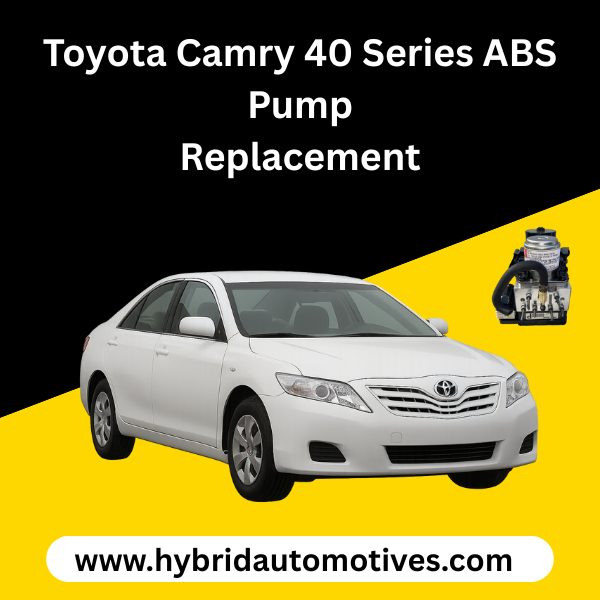
Toyota Camry 40 Series (AHV40, 2007-2011) ABS pump replacement in Sydney at our Belmore workshop. Rebuilt and new OEM options available. Every replacement includes a full diagnostic scan, electronic brake bleeding, system calibration, and a 12-month / 20,000 km warranty. Contact us with your Camry's year and VIN for current pricing.
The Camry 40 Series Hybrid is one of the most common vehicles we see for ABS actuator work. The AHV40 uses a brake actuator assembly that serves as both the ABS controller and the regenerative braking coordinator. This dual role is what makes it fail differently from a conventional Camry's ABS system. When the actuator develops an internal fault, the vehicle triggers multiple dashboard warnings at once, and the braking feel changes noticeably within days.
The Camry 40 Series ABS Problem: What Actually Happens
The AHV40 Camry Hybrid uses a combined brake actuator assembly (Toyota part number 44510-30270 or equivalent) that manages two separate jobs simultaneously. It operates the conventional hydraulic brakes through the ABS pump and solenoid valves, and it coordinates the handover between regenerative braking (which charges the hybrid battery) and friction braking (which slows the wheels mechanically).
This dual-purpose design means the actuator runs far more frequently than a conventional ABS pump. In a non-hybrid Camry, the ABS pump only activates during wheel slip events. In the 40 Series Hybrid, the actuator operates during every single braking event to manage the regenerative-to-friction transition. Over hundreds of thousands of braking cycles, the internal pump motor and solenoid valves accumulate wear that eventually causes pressure loss, erratic braking behaviour, or complete actuator failure.
The 2007 model year is the most commonly affected because it was the first year of the Camry Hybrid in Australia and has now reached 17-19 years of age. The 2008-2011 models follow the same failure path at slightly later mileages.
Warning Signs Specific to the Camry 40 Series
The Camry 40 Series ABS failure presents differently from smaller hybrids like the Aqua or Prius C. Because the Camry is heavier and the actuator handles greater hydraulic loads, the symptoms tend to be more pronounced:
- Multiple warning lights at once. ABS, VSC OFF, and the red Brake warning light all illuminate together. On the Camry 40, these three appearing simultaneously almost always points to the brake actuator rather than a wheel speed sensor or wiring fault.
- Grinding or growling noise from under the dashboard. The Camry 40's actuator is mounted on the firewall, and when the internal pump motor begins to fail, the noise is audible from the driver's seat. It sounds mechanical and internal, starting as an intermittent buzz and progressing to a constant grind.
- Brake pedal goes hard without warning. The regenerative braking system relies on the actuator to provide power-assisted braking. When the actuator loses pressure, pedal resistance increases dramatically. Owners describe it as "standing on a brick." Braking still works but stopping distances increase significantly.
- Intermittent pedal kick-back. Before complete failure, the actuator sometimes produces a pulsing or kick-back sensation through the brake pedal at low speeds. This is the solenoid valves hunting between regenerative and friction braking as internal pressure fluctuates.
- Fault codes stored in the brake ECU. The Camry 40 stores specific codes that identify the actuator problem precisely. These require Toyota Techstream or an equivalent hybrid-capable scanner to read.
Camry 40 Series ABS Fault Codes
The following codes are specific to the Camry 40 Series (AHV40) brake actuator system:
C1256 — Booster Pump Motor The electric pump motor inside the actuator has failed or is underperforming. When this code is stored, the pump can usually be heard struggling (grinding or high-pitched whine) when the brake pedal is pressed. This is the single most common fault code on the Camry 40 Series brake actuator.
C1252 — Accumulator Pressure Sensor Circuit The internal pressure sensor is reading outside its expected range. On the Camry 40, this most often indicates the accumulator is losing pressure internally rather than a sensor failure.
C1254 — Accumulator Pressure Low Similar to C1252 but indicates the pressure has dropped below the minimum threshold. When C1254 stores, the brake pedal is usually already noticeably hard.
C1281 — Brake Actuator Malfunction A broader code indicating the actuator assembly has an internal fault. Often stored alongside C1252 or C1256. Combined with the other codes it confirms the actuator needs attention.
C13B951 — Brake Actuator Assembly Fault (DTC) A Toyota-specific diagnostic trouble code that appears on Techstream and some advanced third-party scanners. Points directly to the brake actuator assembly and usually confirms the unit needs rebuild or replacement rather than a peripheral repair.
C1391 — Accumulator Low Pressure The brake accumulator cannot maintain operating pressure. Often the final code before the actuator fails completely. When C1391 is stored, the vehicle should not be driven until the actuator is repaired or replaced.
A generic OBD-II scanner will not read any of these codes. The Camry 40's brake control system uses Toyota-proprietary C-codes that require Techstream, G-Scan, or equivalent hybrid-capable tools. If your mechanic's scanner shows "no fault codes" but you have ABS/VSC/Brake lights on, the scanner is not reading the correct protocol. See our fault code troubleshooting guide for more information.
Toyota Camry 40 Series ABS Pump Replacement Cost in Sydney
The cost of ABS Pump Replacement depends on the model variant, part choice, and labour complexity. Below is a transparent guide: | Service Type | Average Cost (AUD) | Inclusions |
| Rebuilt ABS Pump Replacement | $850 – $1,200 | Full diagnostic scan, rebuilt unit, bleeding & calibration |
| New OEM ABS Pump Replacement | $1,400 – $1,800 | Genuine Toyota part with 12-Month / 20,000 KM warranty |
| Repair of Existing Unit | $700 – $950 | Bench-tested repair of actuator, leak correction, ECU reset |
Why the Camry 40 Fails Earlier Than You Expect
Three factors combine to make the Camry 40 Series one of the more frequent ABS actuator replacements we handle:
1. The actuator's dual role. Unlike a standard Camry ABS pump that only activates during wheel slip, the Camry 40 Hybrid actuator operates during every braking event. By 150,000 km, the pump motor has completed millions more operating cycles than a non-hybrid equivalent.
2. Vehicle weight. The Camry 40 Hybrid is roughly 1,600 to 1,700 kg, heavier than an Aqua (1,080 kg) or Prius (1,350 kg). The actuator handles greater hydraulic loads at every stop, which accelerates internal wear on the pump motor and solenoid seals.
3. Age of the Australian fleet. The oldest Camry 40 Hybrids (2007 models) are now approaching 20 years old. Even well-maintained examples are reaching the end of the actuator's design life. Brake fluid that was never changed in the first 10 years causes internal corrosion that compounds the mechanical wear.
ABS Pump Replacement Options
We offer two replacement paths for the Camry 40 Series:
- Rebuilt units are the most common choice. The existing actuator housing is retained, and all internal wear components are replaced: pump motor, solenoid valves, seals, accumulator diaphragm, and pressure sensors. The rebuilt unit is pressure-tested, bench-tested, and fitted with a 12-month / 20,000 km warranty.
- Rebuilding is possible when the aluminium housing and internal hydraulic galleries are in good condition. We assess the removed unit before confirming whether a rebuild is viable.
- New OEM units are genuine Toyota brake actuator assemblies. They carry factory specification but availability for the Camry 40 can involve lead times since the model is no longer in production.
- Both options include full diagnostic, electronic bleeding, calibration, and road test.
Contact us with your Camry's year, VIN, or chassis code for current pricing on both options.
Diagnostic and Replacement Process
1. Diagnostic scan and brake system assessment. Full scan using Techstream to read all stored C-codes. We also inspect brake fluid condition, check wheel speed sensor signals, and test the 12V auxiliary battery. A weak 12V can occasionally trigger false ABS warnings on the Camry 40 without any actuator fault.
2. Actuator removal. The brake actuator on the Camry 40 is mounted on the firewall in the engine bay. Removal requires disconnecting hydraulic brake lines (with full contamination control), electrical connections, and mounting hardware. The high-voltage hybrid system is isolated before any work begins.
3. Unit inspection and rebuild or replacement. If rebuilding, the actuator is disassembled, cleaned, inspected, and all wear components replaced. If a new OEM unit is fitted, the old actuator is retained for core assessment.
4. Installation and torque verification. The rebuilt or new actuator is mounted with correct torque specifications. All brake line connections are verified for seal integrity.
5. Electronic brake bleeding and calibration. This is the critical step. The Camry 40's brake system cannot be bled with a standard brake bleeder. Techstream commands the ABS solenoids to cycle in a specific sequence while fluid is introduced, purging all air from the internal galleries. Without this step, the brakes will feel spongy and the warning lights will remain on.
6. Road test and verification. We test braking at multiple speeds, verify regenerative-to-friction handover, clear all stored codes, and confirm no warnings return during a full driving cycle.
Camry 40 vs Camry 50 vs Camry 70: ABS Differences
The three Camry Hybrid generations use different brake actuator assemblies. Parts are not interchangeable:
| Camry 40 (2007-2011) | Camry 50 (2012-2017) | Camry 70 (2018-2021) |
| Chassis | AHV40 | AVV50 | AXVH70 |
| Actuator type | Combined brake booster / ABS / regen controller | Updated integrated unit | Latest generation integrated unit |
| Common failure age | 10-15 years / 150,000+ km | 8-12 years / 120,000+ km | Too new for widespread data |
| Most common code | C1256, C1252 | C1256, C1252 | Limited data |
If unsure which generation you have, check the chassis code on your build plate. Each generation has its own product page: Camry 50 Series ABS and Camry 70 Series ABS.
Toyota Highlander Hybrid: Same Platform
The 2006-2010 Toyota Highlander Hybrid (Kluger Hybrid in Australia) shares its brake actuator platform with the Camry 40 Series Hybrid. The failure modes, fault codes, and repair process are closely related. If you own a Highlander Hybrid showing ABS warnings, the same diagnostic and replacement approach applies. Contact us with your VIN to confirm actuator compatibility.
Maintenance to Extend ABS Actuator Life
The single most effective preventive step is regular brake fluid replacement:
- Flush brake fluid every 2 years or 40,000 km. Most Camry 40 owners have never had this done. If your Camry is 10+ years old and the fluid has never been changed, internal corrosion is likely already present.
- Do not ignore early symptoms. A faint buzzing from the dashboard, or a single instance of a hard pedal that recovers after restart, are early signs of actuator wear. Catching these early means a rebuild is usually possible. Waiting until complete failure often means housing damage that makes only the more expensive full replacement viable.
- Check the 12V auxiliary battery. A weak 12V on the Camry 40 causes voltage drops that confuse the brake ECU. Replacing a 12V battery can prevent false ABS warnings that lead to unnecessary actuator diagnosis.
Sydney Workshop
Appointments at our Belmore workshop, 668 Canterbury Road, Belmore NSW 2192. Same-day completion in most cases when the part is in stock.
Serving Sydney including Bankstown, Greenacre, Campsie, Lakemba, Canterbury, Punchbowl, Ashfield, Burwood, Strathfield, Parramatta, Liverpool, and surrounding areas.
Interstate freight available for rebuilt units. Confirm your mechanic has Techstream or equivalent before ordering.

 Posted on Google

 Jax Gill
Trustindex verifies that the original source of the review is Google.
Such great service! The team were incredibly flexible, helpful and genuine. I called the day before, explained my situation, and they were able to fit me in for an inspection straight away. They gave me honest advice and great recommendations, and genuinely seemed to have my best interests at heart. I really appreciated their help and can not recommend them more highly! They will definitely be my go-to mechanics from now on.Posted on Google Mahedi Hasan
 Usman Ahmad
 Muhammadyusuf Alimov
 Kabin Gurung
 Amritpal Singh Minhas
 Muro A
 arslan bajwa
 Shahzad Nasim
 zain shukat