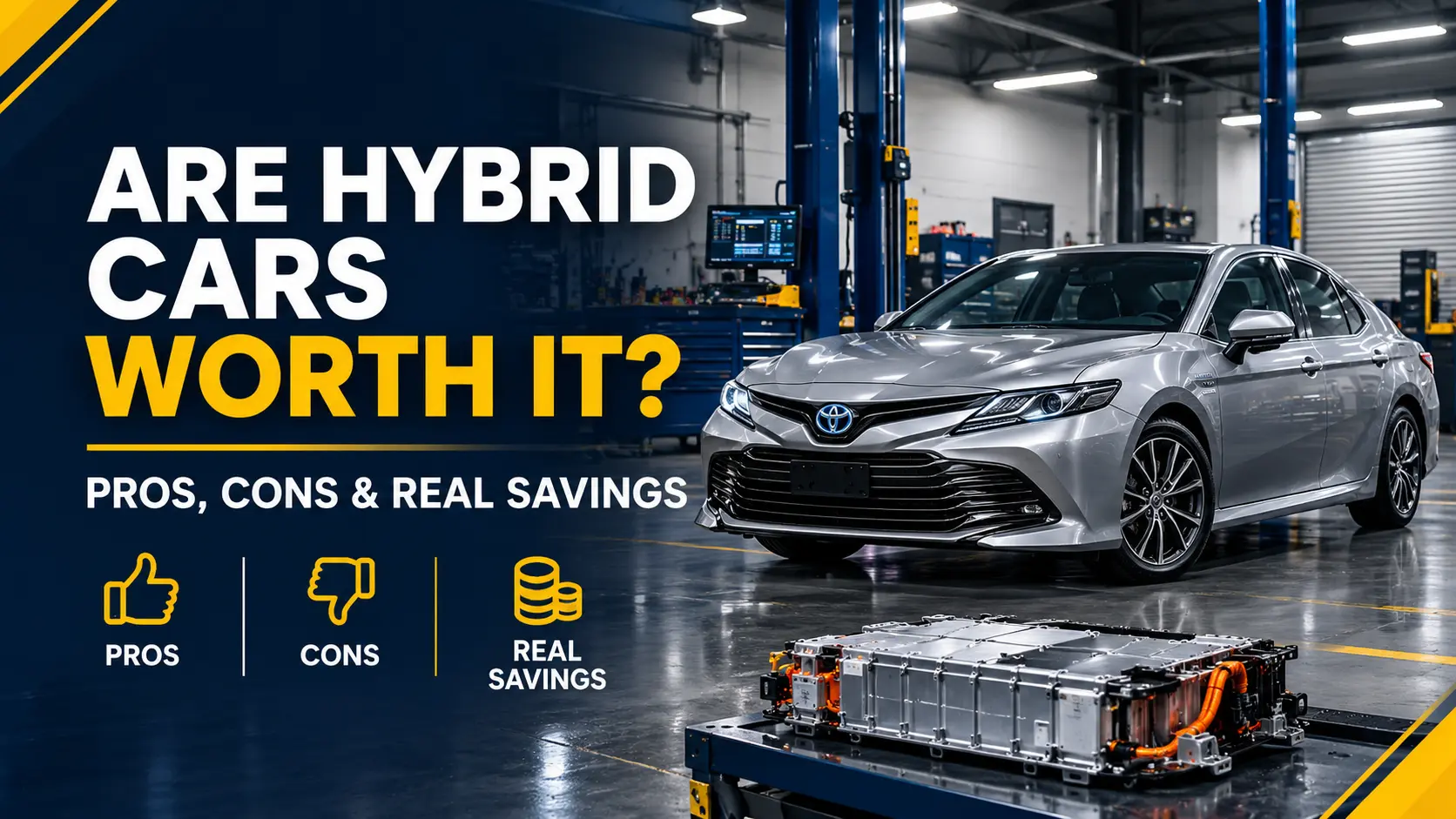
Are Hybrid Cars Worth It? Pros, Cons & Real Savings
For most Australian drivers, yes. A hybrid saves between $600 and $2,200 a year in fuel depending on the model and how you drive. Over five years, that adds up to $3,000–$11,000 in fuel savings alone. Factor in stronger resale values and lower brake wear, and the maths tilts firmly in favour of going hybrid — particularly if you do a lot of city driving.
But not every hybrid suits every driver. And there are costs most buyer guides gloss over — like what happens when the battery warranty runs out, what a replacement actually costs (we’ve fitted thousands of them), and whether a hybrid makes sense if you spend most of your time on the highway.
We’ve put together this guide using real workshop data from our hybrid battery service centres across Australia, current 2026 fuel and vehicle pricing, and the questions our customers ask us most often. No fluff, no sales pitch — just the honest numbers.

What Actually Is a Hybrid Car?
A hybrid car runs on two power sources — a petrol engine and an electric motor. The electric motor handles the low-speed, stop-start stuff (think school drop-offs, crawling through Sydney traffic, reversing into a parking spot). The petrol engine takes over at higher speeds or when you need more grunt.
The clever part is regenerative braking. Every time you lift off the accelerator or tap the brakes, the car captures energy that would otherwise be wasted as heat and feeds it back into the battery. You never plug it in. You never think about it. It just works.
Pros and Cons of Hybrid Cars in Australia
Pros
Fuel savings of $500–$2,300 per year in city driving depending on the model.
Stronger resale value — hybrid RAV4s sell for 25–30% more than petrol versions after three years.
Brake pads last twice as long thanks to regenerative braking doing most of the work.
Quieter and smoother at low speeds — electric mode is nearly silent.
No plugging in required for standard hybrids. Fill with petrol and go.
Proven reliability — Toyota’s hybrid system has been around since 1997. Battery failures within warranty are rare.
Cons
$2,000–$6,000 more expensive upfront than the petrol equivalent.
Minimal fuel savings on highways — the petrol engine runs most of the time at 100+ km/h.
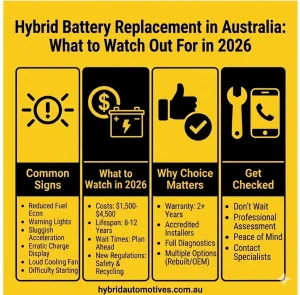
Battery replacement costs $1,500–$9,000 if it fails outside warranty (rare before 200,000km).
Slightly smaller boot space — the battery takes up room under the cargo floor.
No full-size spare tyre in most models — usually a repair kit or space-saver only.
Not suited for heavy towing — lower towing capacity than petrol or diesel equivalents.
The four types you’ll see in Australia
Full Hybrid (HEV) — The most common type. Cars like the Toyota Corolla Hybrid, Hyundai Kona Hybrid and Honda HR-V e:HEV fall here. You fill them with petrol and the electric system manages itself. No plug required.
Plug-in Hybrid (PHEV) — Same idea, but with a much bigger battery that you can charge from a wall socket or charging station. The Mitsubishi Outlander PHEV and BYD Sealion 6 are popular examples. You get 50–150km of pure electric range before the petrol engine kicks in.
Mild Hybrid — A small electric motor assists the petrol engine but never drives the wheels on its own. The Suzuki Swift and Mazda3 use this setup. Fuel savings are modest — roughly 5–10 per cent — but the price premium is smaller too.
Range Extender (REEV/EREV) — The electric motor drives the wheels exclusively, while a small petrol engine acts as a generator to top up the battery. The Nissan X-Trail e-Power and Leapmotor C10 work this way. You never plug them in, but they drive like an EV.
How Much Do You Actually Save on Fuel?
This is the question everyone asks first, and the answer depends entirely on where and how you drive.
Hybrids shine in the city. They struggle to justify themselves on the highway. Here’s why: in stop-start traffic, the electric motor does most of the work. On a motorway at 110km/h, the petrol engine runs almost constantly because the electric motor can’t sustain those speeds alone.
Real fuel cost comparison (2026 Australian prices)
We’ve calculated these using current average petrol prices of $2.10/litre and 15,000km annual driving — which is the Australian average.
| Model | Petrol Version (L/100km) | Hybrid Version (L/100km) | Annual Fuel Cost — Petrol | Annual Fuel Cost — Hybrid | You Save Per Year |
| Toyota Corolla | 6.0 | 4.2 | $1,890 | $1,323 | $567 |
| Toyota RAV4 | 6.0 | 4.7 | $1,890 | $1,481 | $410 |
| Hyundai Tucson | 8.0 | 5.7 | $2,520 | $1,796 | $724 |
| GWM Haval Jolion (urban) | 10.4 | 3.0 | $3,276 | $945 | $2,331 |
Those numbers assume a mix of city and highway driving. If you do 80 per cent or more city driving, your savings jump significantly — sometimes doubling.
If you mostly drive on highways with few stops, your savings shrink to $150–$300 a year. At that rate, it takes over a decade to recoup the price premium.
The breakeven question
Every hybrid costs more than its petrol twin — typically $2,000 to $6,000 more. The question is how long it takes to earn that back in fuel savings.
For a Toyota RAV4 owner who drives mostly in town, the $2,500 premium pays itself off in about three years of urban driving. A GWM Haval Jolion Hybrid owner doing city commutes can break even in under two years.
But here’s what most guides miss — you don’t just break even on fuel. Hybrid owners also benefit from:
- Lower brake wear. Regenerative braking means your brake pads last significantly longer. We regularly see hybrid Camrys come in with original brake pads at 150,000km. That’s rare on a petrol car.
- Stronger resale. A hybrid RAV4 holds roughly 25–30 per cent more resale value than its petrol equivalent after three years, based on current Australian used car market data.
- Less engine strain. The petrol engine in a hybrid works less hard, which can translate to fewer mechanical issues over the life of the car.
When you stack fuel savings, brake savings and resale together, most hybrid owners come out ahead within three to four years.
The Costs Nobody Talks About
Hybrid battery replacement — what it really costs
This is the big fear. And it’s understandable — nobody wants a surprise $10,000 repair bill. But the reality is much less dramatic than the internet would have you believe.
Here’s what we see in our workshops every day:
Most hybrid batteries last well beyond their warranty period. Toyota and Lexus hybrid batteries regularly reach 200,000–300,000km before showing meaningful degradation. We service vehicles across Sydney, Melbourne, Brisbane and Hobart, and premature battery failure within the warranty period is genuinely uncommon.
When a battery does eventually need replacing, the cost depends on where you go:
| Dealer Replacement | Specialist Replacement (like us) | |
| Toyota Camry/Corolla | $3,500–$6,000 | $1,800–$3,500 |
| Toyota Prius | $3,000–$5,000 | $1,500–$3,000 |
| Lexus CT200h/RX450h | $5,000–$9,000 | $2,500–$5,000 |
The difference is significant. Dealerships typically replace the entire battery assembly with a brand-new unit. A specialist can test individual cells, replace only the faulty modules and recondition the pack — saving you 40–60 per cent while delivering comparable performance and longevity.
What we tell our customers: if your hybrid is under eight years old and has fewer than 200,000km, battery failure is unlikely. If you’re buying a used hybrid over 10 years old, factor in $2,000–$4,000 for a potential battery service or replacement. It’s cheap insurance for peace of mind.
Insurance — slightly more, but not dramatically
Hybrid insurance premiums run about 3–5 per cent higher than the petrol equivalent for mainstream brands like Toyota, Hyundai and Kia. On a $40,000 car, that’s roughly $40–$70 extra per year. For luxury hybrids like Lexus, the gap widens to $300–$500 because the vehicle value is higher and parts cost more.
Servicing — basically the same
This surprises people. Routine servicing for a hybrid costs about the same as the petrol version. Toyota charges identical capped-price servicing for Corolla Hybrid and Corolla petrol. Hyundai’s Tucson Hybrid costs roughly $30 more per service than the petrol.
The hybrid system itself — the battery, electric motor and inverter — requires almost zero maintenance under normal conditions. There are no spark plugs on the electric side, no transmission fluid changes for the eCVT, and the regenerative braking means far less dust and wear on brake components.
Hybrid vs Petrol: Which One Suits You?
A hybrid makes strong sense if you:
- Drive mostly in the city or suburbs. This is where hybrids earn their keep. Stop-start traffic, school runs, shopping trips, daily commutes under 50km — the electric motor handles a huge chunk of this driving.
- Plan to keep the car for five years or more. The longer you own it, the more the fuel savings compound. After five years of average driving, a Corolla Hybrid owner has saved roughly $2,800 in fuel alone compared to the petrol version.
- Care about resale value. Hybrids consistently outperform their petrol twins at resale. With fuel prices volatile and hybrid demand growing, this trend looks set to continue.
- Want a quieter, smoother drive. At low speeds, a hybrid running on electric power is genuinely pleasant. No engine drone, no vibrations, just smooth, quiet motion.
Stick with petrol if you:
- Drive primarily on highways and rural roads. Long stretches at constant speed negate most of the hybrid’s fuel advantage. A modern petrol engine is already quite efficient at highway cruising speeds.
- Need serious towing capacity. Most hybrids aren’t designed for heavy towing. If you regularly pull a caravan, boat or trailer, a diesel or turbo petrol SUV will serve you better.
- Are on a very tight budget. The $2,000–$6,000 upfront premium matters if cashflow is tight. While you’ll earn it back over time, that only helps if you can afford the initial outlay.
- Plan to sell within two years. You won’t hold the car long enough to recoup the premium through fuel savings — though the stronger resale value helps close the gap.
Best Hybrid Cars in Australia for 2026-27
Here are the models we see and service most often — and what our customers tell us about living with them.
Toyota Corolla Hybrid — The default choice for a reason. Reliable, cheap to run, proven technology. The hybrid system has been refined over multiple generations and battery issues are extremely rare. Fuel consumption sits around 4.2L/100km in real-world driving.
Toyota RAV4 Hybrid — Australia’s best-selling SUV in hybrid form. Practical, spacious, strong resale. The only complaint we hear regularly is waiting times for new orders.
Hyundai Kona Hybrid — Compact, well-equipped and about $18,000 cheaper than the fully electric Kona. A smart entry point for buyers who want electrification without the charging hassle.
Kia Sportage Hybrid — Looks sharp, comes loaded with tech, and Kia’s seven-year warranty provides solid coverage. Fuel economy in the city is genuinely impressive at 3.6L/100km.
Honda Civic Hybrid — Honda’s latest hybrid system is brilliant. The Civic delivers fuel consumption as low as 2.0L/100km in urban driving, which is remarkable for a car this size.
GWM Haval Jolion Hybrid — The budget option. Cheapest hybrid SUV in Australia and the urban fuel savings are enormous. The trade-off is that highway efficiency drops off more sharply than Toyota or Hyundai equivalents.
Used Hybrid Buying — What to Check
Buying a second-hand hybrid is generally safe, but there are a few things worth checking that you wouldn’t worry about with a petrol car:
Check the hybrid battery health. Most workshops (including ours) can run a diagnostic scan that shows battery cell balance and state of health. This takes about 30 minutes and tells you whether the battery is in good shape or nearing the end of its useful life.
Check the warranty status. Toyota offers a 10-year hybrid battery warranty (unlimited km). Honda offers eight years. Kia offers seven years/150,000km. These warranties are transferable to second owners, so check what’s remaining.
Look at the service history. Hybrid systems are low-maintenance, but they’re not no-maintenance. Regular servicing keeps the cooling system clean, which is critical for battery longevity. A car with gaps in the service record is a bigger risk.
Listen for warning lights. The “Check Hybrid System” warning is the one you don’t want to see. If it’s showing on a test drive, walk away — or at least get a specialist inspection before committing.
Don’t panic about age. We regularly service Toyota Prius and Camry Hybrids with 250,000+ km on the original battery. These systems are tougher than people give them credit for.
What About the Environment?
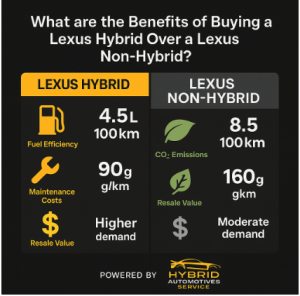
Hybrids produce fewer tailpipe emissions than petrol cars — typically 20–40 per cent less CO2 in mixed driving. In pure electric mode around town, emissions drop to zero from the exhaust.
They’re not as clean as a full EV, but for drivers who can’t charge at home, lack access to charging infrastructure, or frequently drive long distances, a hybrid is a meaningful improvement over straight petrol without the compromises that come with going fully electric.
Australia’s New Vehicle Efficiency Standard (NVES), which kicked in during 2025, is pushing manufacturers to offer more hybrid and electric options. That means more choice for buyers and potentially sharper pricing as competition increases.
Frequently Asked Questions
How long do hybrid batteries last in Australia?
Most hybrid batteries last 8–15 years or 200,000–350,000km under normal Australian driving conditions. Toyota’s systems are particularly long-lived — we regularly see original batteries still performing well past 250,000km. Heat is the main enemy, so cars driven extensively in extreme outback heat may see slightly shorter battery life.
How much does it cost to replace a hybrid battery in Australia?
Through a dealership, expect $3,000–$9,000 depending on the model. Through a hybrid battery specialist, costs typically run $1,500–$5,000. The difference comes down to whether the entire pack is replaced or individual cells are reconditioned — both approaches work, and a specialist can advise which makes more sense for your car.
Do hybrid cars need to be plugged in?
Standard hybrids (HEVs) — no. They charge themselves through the engine and regenerative braking. Plug-in hybrids (PHEVs) — yes, to get the most out of them. A PHEV that’s never plugged in uses more fuel than it should because it’s dragging a heavy battery around without using it.
Are hybrid cars good for long-distance driving?
They work fine on long drives — you just won’t see the big fuel savings you’d get in the city. On the highway, a hybrid uses its petrol engine most of the time, so fuel consumption is closer to a standard petrol car. Some hybrids, particularly the Lexus RX Hybrid and Kia Sorento Hybrid, still achieve respectable highway economy due to their efficient powertrains.
Do hybrids hold their resale value in Australia?
Yes — and often better than petrol equivalents. Toyota hybrid models currently hold 25–30 per cent more resale value than their petrol counterparts after three years. Growing fuel prices and increased demand for fuel-efficient vehicles are driving this trend.
Is it worth buying a used hybrid car?
Generally yes, with caveats. Get the hybrid battery health checked before purchase, verify remaining warranty coverage, and review the service history. A well-maintained used hybrid with a healthy battery is one of the best value propositions in the Australian car market right now.
Can you drive a hybrid if the battery fails?
Technically some hybrids can limp along on petrol only, but performance and fuel economy suffer badly. More importantly, driving with a failing battery can damage other hybrid components. If your battery warning light comes on, get it inspected promptly.
What’s cheaper to run overall — a hybrid or a petrol car?
Over five years of average Australian driving (15,000km/year, mixed city/highway), a hybrid typically costs $2,500–$8,000 less to run than its petrol equivalent when you factor in fuel, servicing and brake wear. The exact figure varies by model and driving patterns.
Need a hybrid battery health check or replacement? Get in touch with our team — we service Toyota and Lexus hybrid systems across Sydney, Melbourne, Brisbane and Hobart.