
ABS Pump Explained: How It Works, Parts & Common Faults
An ABS pump is a hydraulic component inside your car’s anti-lock braking system that regulates brake fluid pressure to prevent your wheels from locking up during hard braking. It works alongside the ABS control module and wheel speed sensors to keep you in control when you need to stop suddenly — whether on a wet road, loose gravel, or in an emergency.
Nearly every modern vehicle has an ABS pump fitted as standard. But most drivers only think about it when something goes wrong: a warning light appears on the dashboard, the brake pedal feels different, or the car doesn’t stop the way it should.
In this guide, we break down exactly what an ABS pump does, what parts it’s made of, how it works step by step, the most common failure signs to watch for, and when it’s time for a repair or replacement. This is based on what we see daily in our workshop servicing Toyota and Lexus hybrid ABS systems across Australia.

What Does an ABS Pump Do?
The ABS pump’s job is straightforward: it controls the hydraulic pressure going to your brakes so your wheels never fully lock up when you brake hard.
When you slam the brakes, one or more wheels can decelerate faster than the others — especially on uneven or slippery surfaces. If a wheel locks completely, it loses traction and your tyre starts sliding across the road instead of gripping it. That means you lose steering control, your stopping distance increases, and the car can skid.
The ABS pump prevents this by rapidly adjusting the brake fluid pressure to each wheel independently. It releases pressure on a wheel that’s about to lock, then reapplies it once the wheel is rotating again. This cycle happens multiple times per second — far faster than any driver could manage by pumping the brake pedal manually.
The result is that your tyres maintain contact with the road surface throughout the stop, giving you the ability to steer around obstacles even while braking at full force.
ABS Pump vs ABS Module — What’s the Difference?
People often use “ABS pump” and “ABS module” interchangeably, but they’re different parts that work together. The ABS module is the electronic brain — a circuit board that processes sensor data and decides when to activate the system. The ABS pump is the mechanical side — the hydraulic unit with valves and a motor that physically changes the brake pressure based on the module’s instructions.
In older vehicles, these were separate components mounted in different locations. In modern cars, including the Toyota and Lexus hybrids we service, the module and pump are built together as a single combined unit, often referred to simply as the “ABS pump assembly.” When one part fails, the entire unit usually needs attention.
Components of an ABS Pump
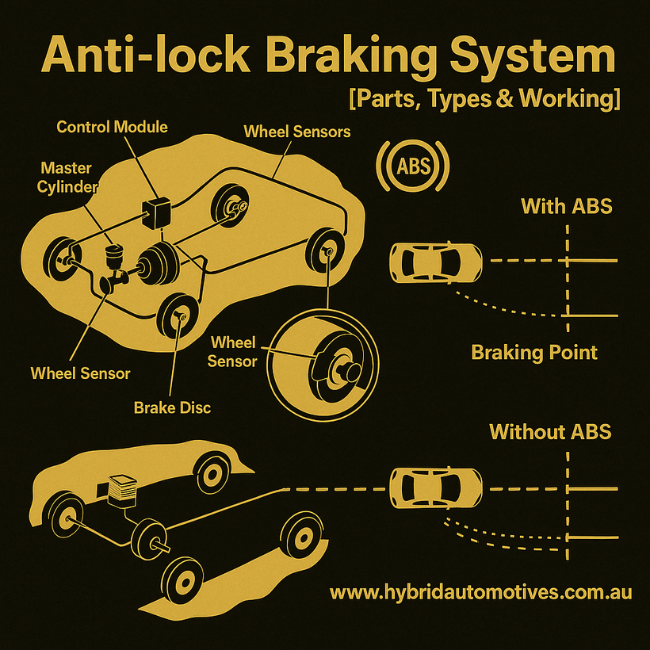
An ABS pump assembly is made up of four main components that work together to regulate braking pressure. Understanding each part helps you recognise what’s failing if your ABS develops a problem.
1. Hydraulic Unit (Valve Body)
The hydraulic unit is the core of the ABS pump. It contains a set of solenoid valves — typically two per wheel circuit (one inlet valve and one outlet valve), giving most passenger cars eight valves in total. These valves open and close rapidly to increase, hold, or decrease brake fluid pressure to individual wheels.
The valve body also houses the internal fluid passages that connect the master cylinder (where your brake pedal pressure starts) to each wheel’s brake caliper. When the ABS activates, the valves redirect fluid flow through these passages to control exactly how much braking force reaches each wheel.
2. Electric Motor and Pump
Attached to the bottom of the hydraulic unit is a small but powerful electric motor. This motor drives a set of pistons inside the pump that physically move brake fluid through the system.
During normal braking, the motor sits idle. It only activates when the ABS control module detects a wheel is about to lock up and needs pressure restored after the valves have released it. The motor spins up quickly and pushes fluid from a low-pressure accumulator back into the high-pressure brake lines, ready for the next braking pulse.
In the Toyota and Lexus hybrids we work on daily — models like the Camry, Prius, and CT200H — the pump motor is a common failure point. It can wear out over time or develop electrical faults that trigger ABS warning lights.
3. Electronic Control Unit (ECU)
The ECU is the decision-maker of the ABS system. It’s a small circuit board mounted directly on top of the hydraulic unit in modern vehicles. The ECU continuously receives speed data from each wheel sensor, compares the readings, and determines whether any wheel is decelerating too quickly relative to the others.
When it detects a potential lock-up, the ECU sends precise electrical signals to the solenoid valves and pump motor, orchestrating the rapid pressure changes that keep the wheel rotating. The ECU also stores diagnostic trouble codes (DTCs) when something goes wrong, which technicians read using an OBD-II scanner to pinpoint faults.
4. Wheel Speed Sensors
Each wheel has a sensor — either a passive magnetic sensor or an active Hall-effect sensor — that measures how fast that wheel is rotating. The sensor reads a toothed ring (also called a reluctor or tone ring) mounted on the wheel hub or axle, generating a signal that changes frequency as the wheel speeds up or slows down.
The ECU relies entirely on these sensors to know what’s happening at each corner of the car. If a sensor fails, gets dirty, or its wiring is damaged, the ECU can’t accurately monitor that wheel and may disable the ABS entirely as a safety precaution. Sensor faults are one of the most common ABS issues we see — and fortunately, one of the simplest to fix.
How Does an ABS Pump Work?
The ABS pump operates through a rapid cycle of detecting, releasing, and restoring brake pressure. The entire process happens automatically and takes milliseconds. Here’s how it works, step by step.
Step 1: Wheel Speed Detection
While you drive, the wheel speed sensors continuously send rotation data to the ABS control module. Under normal braking, all four wheels slow down at roughly the same rate and the ABS stays inactive — your brakes work as a standard hydraulic system.
Step 2: Lock-Up Detection
When you brake hard — or when one wheel hits a slippery patch — the ECU notices that one or more wheels are decelerating much faster than the others. This rapid deceleration signals that the wheel is about to lock up. The ECU activates the ABS within milliseconds of detecting this imbalance.
Step 3: Pressure Modulation
Once activated, the ECU commands the solenoid valves in the hydraulic unit to reduce brake pressure on the affected wheel. The outlet valve opens, releasing fluid from the brake line into a low-pressure accumulator. The wheel begins rotating again.
The pump motor then kicks in, drawing that released fluid from the accumulator and pushing it back into the main brake circuit. The inlet valve reopens, and pressure is reapplied to the brake. This cycle of release, restore, and reapply happens up to 15 times per second — which is what creates the pulsing sensation you feel through the brake pedal during an ABS stop.
Step 4: Return to Normal Braking
The ECU continuously monitors wheel speeds throughout the entire braking event. As the vehicle slows down and the risk of lock-up passes, the ABS deactivates and the brakes return to normal hydraulic operation. The pump motor switches off and the valves return to their resting positions.
How ABS Connects to Other Safety Systems
Modern vehicles don’t use ABS in isolation. The same hardware — the pump, valves, sensors, and ECU — also supports traction control (which prevents wheel spin during acceleration) and electronic stability control (which helps prevent the car from sliding sideways during cornering). These systems share the ABS pump assembly, which is one reason why a pump failure can trigger multiple warning lights on your dashboard, not just the ABS light.
For a deeper look at the mechanisms involved in ABS pump operation, see our detailed technical guide.
Signs Your ABS Pump Is Failing
ABS pump problems don’t always announce themselves dramatically. Often the first sign is subtle — a dashboard light, a slightly different pedal feel, or a noise you haven’t heard before. Here are the symptoms we see most often in our workshop, and what typically causes them.
ABS Warning Light Stays On
This is the most obvious sign. When the ABS control module detects a fault anywhere in the system — a sensor issue, a valve that isn’t responding, or a pump motor that won’t run — it illuminates the ABS warning light and stores a diagnostic trouble code. Your regular brakes still work, but the anti-lock function is disabled until the fault is fixed.
In some cases, the traction control and stability control lights come on at the same time, because those systems share the ABS hardware.
Brake Pedal Feels Spongy or Goes to the Floor
If the ABS pump develops an internal leak or one of its valves sticks open, brake fluid pressure can drop. You’ll notice the brake pedal feels softer than usual, or you need to push it further down before the brakes engage. This one needs immediate attention — it affects your basic braking ability, not just the ABS.
Wheels Lock Up During Hard Braking
The whole point of ABS is to prevent wheel lock-up. If your wheels are skidding and sliding when you brake hard, the ABS isn’t doing its job. This usually points to a pump motor failure (the pump can’t restore pressure fast enough), a faulty control module, or a failed wheel speed sensor sending incorrect data.
Unusual Buzzing or Grinding Noises
A healthy ABS pump makes a brief buzzing or humming sound when it activates during hard braking — that’s normal. But if you hear the pump running when you’re not braking hard, or if it makes grinding or clicking noises, the pump motor may be wearing out or running continuously due to a pressure leak in the hydraulic circuit.
In Toyota and Lexus hybrids, the ABS pump can sometimes run on startup for a few seconds to pressurise the system — this is normal behaviour. But if it runs for extended periods or cycles on and off repeatedly, that’s a fault.
Longer Stopping Distances
This is the hardest symptom to notice because it happens gradually. As ABS components wear, the system becomes less effective at optimising brake pressure. You may not realise your stopping distance has increased until you need to brake hard and the car doesn’t respond as quickly as expected.
What Causes These Failures?
The underlying causes typically fall into a few categories. Sensor faults from dirt buildup, corrosion, or damaged wiring are the most common and least expensive to fix. Contaminated brake fluid — moisture, air bubbles, or debris getting into the hydraulic system — can damage the pump’s internal valves and pistons over time. Electrical faults in the control module, such as corroded solder joints or failed capacitors, are particularly common in vehicles over 8–10 years old. And physical damage to brake lines, sensor wiring, or the unit itself from road debris or poor handling during unrelated repairs can cause issues at any age.
On the Toyota Camry and Lexus CT200H hybrids specifically, we frequently see pump motor failures and module circuit faults as the most common reasons for ABS pump replacement.
ABS Pump Diagnosis and Repair
Diagnosing an ABS pump problem starts with reading the fault codes stored in the ABS control module, but the codes alone rarely tell the full story. Proper diagnosis requires a combination of electronic scanning, visual inspection, and hands-on testing.
How ABS Faults Are Diagnosed
The first step is connecting an OBD-II diagnostic scanner that supports ABS-specific codes. Generic code readers that only pull engine codes won’t work here — you need a scanner that can communicate with the ABS module directly. The fault codes narrow down which part of the system is affected: a sensor circuit, the pump motor, a valve, or the module itself.
From there, a technician inspects the physical components. Wheel speed sensors and their wiring are checked for damage, corrosion, or contamination. The tone rings on each wheel hub are examined for cracks or missing teeth. The brake fluid is inspected for moisture content and contamination. And the pump itself is tested to confirm the motor runs when commanded and the valves respond correctly.
Common ABS Repairs
Not every ABS problem means replacing the entire unit. The most common repairs include replacing a faulty wheel speed sensor or its wiring harness, which is a relatively straightforward and affordable fix. Flushing contaminated brake fluid and bleeding the ABS hydraulic circuit can resolve pressure-related issues. Replacing corroded or damaged connectors and wiring restores communication between sensors and the module.
However, when the pump motor has failed, a valve is stuck internally, or the control module’s circuit board has developed faults, the repair typically involves replacing or rebuilding the combined ABS pump and module assembly. In some cases, a specialist can rebuild the module by replacing failed electronic components — this can be significantly cheaper than fitting an entirely new unit.
DIY or Professional?
ABS pump work is not a typical DIY job. The system operates under high hydraulic pressure, requires specialist diagnostic tools, and needs to be bled and calibrated correctly after any repair. Incorrect work can leave you with reduced braking performance or a system that doesn’t activate when you need it most.
If your ABS warning light is on, the safest approach is to have the system scanned and inspected by a technician who specialises in your vehicle type. For Toyota and Lexus hybrids, ABS systems have additional complexity because they integrate with the regenerative braking system — which is one of the reasons we recommend working with a specialist workshop that understands these systems.
Should You Pump ABS Brakes?
No, and doing so can actually make things worse.
Pumping the brake pedal is a technique from the era before ABS, when manually releasing and reapplying the brakes was the only way to prevent wheel lock-up on slippery roads.
With ABS, the system does this for you — and it does it far better. The ABS pump modulates brake pressure up to 15 times per second on each wheel independently. No human can match that speed or precision.
When you pump the pedal on a car with ABS, you’re actually interrupting the system. Each time you lift off the pedal, you release the hydraulic pressure that the ABS is trying to regulate. The system has to restart its cycle each time, which increases your stopping distance and reduces your control.
The correct technique with ABS is simple: press the brake pedal firmly and hold it. Don’t let up, even if you feel the pedal pulsating or hear a buzzing noise — that’s the ABS working as designed. Keep your foot firmly on the brake and steer around the hazard if needed. The ABS will handle the pressure modulation while you focus on steering.
ABS Pump Replacement at Hybrid Automotives
If your ABS pump has failed or your ABS warning light won’t clear after diagnosis, replacement is usually the most reliable solution — especially when the pump motor or internal module circuitry is damaged beyond repair.
At Hybrid Automotives, we specialise in ABS pump replacement for Toyota and Lexus hybrid vehicles across Australia. Our process includes full diagnostic scanning to confirm the ABS pump is the root cause, testing the replacement unit to manufacturer specifications before fitting, proper bleeding and calibration of the ABS hydraulic system after installation, and clearing all stored fault codes and verifying the system is fully operational.
Toyota ABS Pump Replacement
We carry and fit ABS pump units for a wide range of Toyota hybrid models, including the Toyota Camry 40, 50, and 70 Series, Toyota Prius, Toyota Corolla, Toyota Aqua, Toyota Yaris, and the Toyota Estima. See all Toyota ABS pump options.
Lexus ABS Pump Replacement
For Lexus hybrids, we service the Lexus CT200H, Lexus ES300H, Lexus IS300H, Lexus NX300H, Lexus RX400H, and the Lexus RX450H. See all Lexus ABS pump options.
We service customers from our workshop in Belmore, NSW, and ship replacement units Australia-wide to Brisbane, Melbourne, Hobart, and beyond.
Book an ABS pump diagnosis or replacement →
Or call us on +61 493 688 444 to discuss your vehicle.
Frequently Asked Questions
What is an ABS pump in a car?
The ABS pump is a hydraulic component in your car’s anti-lock braking system. It regulates brake fluid pressure during hard braking to prevent your wheels from locking up, helping you maintain steering control and traction on the road.
What are the components of an ABS system?
An ABS system has four main components: wheel speed sensors on each wheel that monitor rotation, an electronic control unit (ECU) that processes sensor data and makes decisions, a hydraulic unit with solenoid valves that control fluid flow, and an electric pump motor that restores brake fluid pressure after each braking pulse.
What is the function of ABS?
The ABS prevents wheel lock-up during emergency or hard braking by rapidly adjusting brake pressure on individual wheels. This allows you to steer while braking hard and helps reduce stopping distance, particularly on wet, icy, or uneven road surfaces.
What is the purpose of ABS brakes?
ABS brakes keep you in control during sudden stops. Without ABS, hard braking can lock your wheels and cause the car to skid in a straight line regardless of where you steer. ABS modulates the brake pressure automatically so your tyres keep gripping the road and you retain the ability to steer.
Should you pump anti-lock brakes?
No. ABS pumps the brakes for you automatically at up to 15 times per second — far faster than any person can manage. With ABS, simply press the brake pedal firmly and hold it down. Pumping the pedal yourself actually interrupts the system’s cycle and increases your stopping distance.
What happens when an ABS pump fails?
When an ABS pump fails, the ABS warning light is illuminated on your dashboard and the anti-lock function is disabled. You may notice a spongy brake pedal, longer stopping distances, or wheels locking up during hard braking. Your standard brakes will still work, but you lose the anti-lock protection that prevents skidding.


