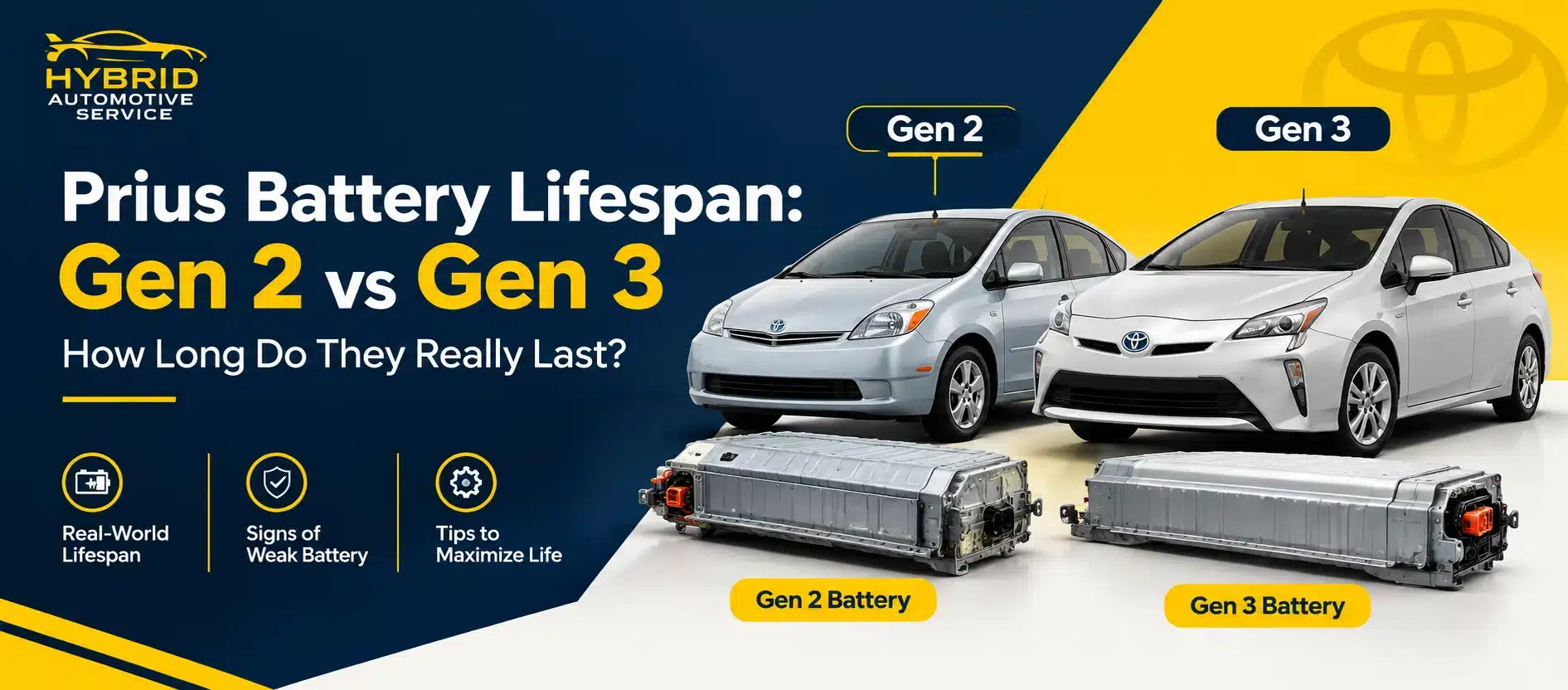
Prius Battery Lifespan: Gen 2 vs Gen 3 — How Long Do They Really Last?
Key Takeaways
- Gen 2 Prius (NHW20, 2004-2009): Typical battery lifespan of 8 to 12 years or 150,000 to 250,000 km. Most original batteries have already been replaced or are well past due.
- Gen 3 Prius (ZVW30, 2009-2015): Typical battery lifespan of 10 to 15 years or 200,000 to 300,000 km. This generation is now entering its peak failure window, and workshop volume reflects it.
- Both generations use 201.6V nickel-metal hydride (NiMH) packs with 28 modules, but the Gen 3 has improved thermal management that extends its life by roughly 2-3 years under similar driving conditions.
- Driving pattern matters more than model year. A gently driven 2006 Gen 2 can outlast a hard-driven 2012 Gen 3 rideshare vehicle.
Why This Comparison Matters Right Now
If you are reading this in 2026, you are sitting at a very specific point in the Prius ownership timeline. The Gen 2 fleet is 17 to 22 years old. Almost every original battery in a Gen 2 has either been replaced, is actively failing, or is running on borrowed time. The Gen 3 fleet is 11 to 17 years old and is now entering the 10 to 15 year window where battery degradation goes from gradual to noticeable.
In the workshop, the shift is obvious. Five years ago, most Prius battery work was Gen 2 replacements. Today, the Gen 3 has overtaken it as the most common Prius generation coming through for battery diagnosis. Understanding the differences between these two generations helps owners make informed decisions about whether to replace, sell, or keep driving.
Gen 2 vs Gen 3 Prius Battery: The Technical Differences
Gen 2 and Gen 3 Prius use nickel-metal hydride (NiMH) battery chemistry. Both run at 201.6 volts. Gen 2 and Gen 3 contain 28 individual modules. On paper, the batteries look nearly identical. In practice, they age differently because of engineering changes Toyota made between the two generations.
| Specification | Gen 2 (NHW20) | Gen 3 (ZVW30) |
|---|---|---|
| Production years | 2004-2009 | 2009-2015 |
| Battery voltage | 201.6V | 201.6V |
| Battery chemistry | NiMH | NiMH |
| Module count | 28 | 28 |
| Module voltage | 7.2V each | 7.2V each |
| Engine | 1.5L 1NZ-FXE | 1.8L 2ZR-FXE |
| Electric motor output | 67 HP | 80 HP |
| Combined system output | 110 HP | 134 HP |
| Typical battery lifespan | 8-12 years / 150,000-250,000 km | 10-15 years / 200,000-300,000 km |
| Battery cooling | Cabin air intake, single fan | Improved cabin air intake, better duct routing |
| Current fleet age (2026) | 17-22 years | 11-17 years |
The numbers that matter most are at the bottom of that table. The Gen 3’s improved cooling system is the single biggest reason it outlasts the Gen 2 by roughly 2-3 years under comparable conditions. Better airflow across the battery pack means lower sustained temperatures, and lower temperatures mean slower chemical degradation inside each module.
How Long Does a Gen 2 Prius Battery Actually Last?
Direct answer: 8 to 12 years in typical private use, or roughly 150,000 to 250,000 km. Rideshare and taxi Gen 2 vehicles often reached end of battery life in 5 to 8 years.
The Gen 2 Prius (NHW20) was produced from 2004 to 2009. Every single Gen 2 on the road today is at least 17 years old. At this point, the question for most Gen 2 owners is not “will my battery fail” but “has it already been replaced, and if not, how much longer can I realistically expect.”
In the workshop, we rarely see a Gen 2 with its original battery still performing well. The ones that do still have original packs are almost always low-mileage private vehicles that spent most of their life in moderate climates with regular driving patterns. A Gen 2 that sat in a garage for months at a time, or one that spent years in a hot climate, is unlikely to have an original battery that still holds useful capacity.
Common Gen 2 battery failure patterns:
- Fuel economy drops from the original 4.5-5.0L/100km (47-52 mpg) range toward 7-8L/100km (30-34 mpg)
- The petrol engine runs constantly at low speeds where the car used to glide on electric power
- The battery charge gauge swings rapidly between full and empty during normal driving
- Fault code P0A80 (replace hybrid battery) stores in the hybrid control module
- The red triangle warning light appears on the dashboard, sometimes intermittently at first
What kills Gen 2 batteries specifically:
The Gen 2’s battery cooling system draws air through a vent located behind the rear passenger seat on the right side. Over years of use, this vent and the fan behind it clog with dust, pet hair, and cabin debris. Airflow drops, battery temperature rises, and the modules degrade faster than they should. Most Gen 2 owners never knew this vent existed, let alone that it needed cleaning. By the time the battery shows symptoms, years of reduced cooling have already shortened the pack’s life.
The Gen 2 also uses an older battery management system (BMS) that is less sophisticated than the Gen 3’s. It allows the modules to drift further out of balance before intervening, which means weak modules get weaker while strong modules compensate. Over time, this imbalance accelerates the failure of the weakest modules and brings down the whole pack.
How Long Does a Gen 3 Prius Battery Actually Last?
Direct answer: 10 to 15 years in typical private use, or roughly 200,000 to 300,000 km. Rideshare and taxi Gen 3 vehicles typically need replacement at 6 to 10 years regardless of distance.
The Gen 3 Prius (ZVW30) was produced from 2009 to 2015. The earliest Gen 3 vehicles are now 17 years old, while the latest are 11. This generation is now in the thick of the battery failure window, and it shows in workshop volume. The Gen 3 is currently the most common Prius coming in for battery diagnosis and replacement.
The Gen 3 outlasts the Gen 2 by roughly 2-3 years on average, and the reasons are practical rather than revolutionary. Toyota did not change the battery chemistry or voltage. What they changed was the cooling, the battery management software, and the way the hybrid system loads the battery during driving.
What Toyota improved in the Gen 3:
The cooling duct routing is more efficient. The air intake for the battery fan is repositioned and draws slightly more volume. The battery management system is better at keeping modules balanced, which prevents the runaway imbalance that kills Gen 2 packs. And the Gen 3’s larger 1.8L engine means the hybrid system relies less heavily on the battery for acceleration, which reduces the depth of discharge cycles compared to the Gen 2’s 1.5L engine working harder to deliver the same performance.
Common Gen 3 battery failure patterns:
- Gradual fuel economy decline over 6-12 months (often the first sign, noticed long before any warning light)
- P0A80 (replace hybrid battery) or P0A7F (battery deterioration) fault codes
- The “Check Hybrid System” warning appearing on the multi-information display
- Reduced power during acceleration, particularly when cold or when climbing hills
- The battery cooling fan running louder or more frequently than it used to (the fan works harder as battery resistance increases with age)
The Gen 3 cooling fan problem is real but different from the Gen 2. The Gen 3 fan is located under the rear seat on the right side (similar position to the Gen 2 but with improved duct design). It still clogs, and cleaning it still extends battery life. But because the Gen 3’s overall thermal management is better, a clogged fan takes longer to cause noticeable damage than on a Gen 2. This is why some Gen 3 owners make it to 12 or even 15 years without cleaning the fan and still have a functioning battery. They got lucky with the thermal margin Toyota built in, not because the fan did not need cleaning.
Why Driving Pattern Matters More Than Generation
This is the part most comparison articles leave out, and it is the part that actually determines your battery’s lifespan.
A Prius hybrid battery is rated by charge cycles, not calendar years or kilometres. Every time the battery charges and discharges (which happens continuously during normal driving), it uses a small portion of its total chemical life. Two identical Priuses of the same generation can have battery lives a decade apart depending on how they are driven.
Private suburban driving (best case for battery life): One or two moderate charge-discharge cycles per trip. A 30 km commute each way might cycle the battery once or twice. Over a year of typical private use, the battery sees roughly 500-1,000 full-equivalent cycles.
Rideshare or taxi driving (worst case): Six to ten charge-discharge cycles per shift. Stop-start city traffic in Sydney or Melbourne means the battery is constantly cycling between regenerative charging (slowing down) and electric assist (accelerating). A full-time rideshare Prius may accumulate 2,000-4,000 full-equivalent cycles per year.
This is why a 2006 Gen 2 driven gently by a retiree doing 10,000 km per year can still have a functioning original battery in 2026, while a 2013 Gen 3 used for Uber since 2016 may have needed a new battery by 2022. The generation matters, but the duty cycle matters more.
How Climate Affects Prius Battery Life in Australia
Australia’s climate range is a factor that owners in the UK or Japan do not face to the same degree. A Prius in Hobart lives a very different thermal life from one in Darwin or Western Sydney.
Hot climates (inland NSW, QLD, WA, NT): Heat is the enemy of NiMH battery chemistry. Sustained ambient temperatures above 35 degrees Celsius accelerate internal degradation. A Prius regularly parked in direct sun in Western Sydney’s summer heat will lose battery capacity faster than the same car parked in a garage in Melbourne.
Moderate climates (coastal Sydney, Melbourne, Adelaide): The best conditions for Prius battery longevity in Australia. Moderate temperatures and regular driving keep the battery in its optimal operating range.
Cold climates (Canberra, Hobart, Alpine regions): Cold does not damage the battery chemistry directly, but the battery produces less power when cold. The hybrid system compensates by running the petrol engine more, which means less regenerative charging and slightly different cycling patterns. The net effect on lifespan is minimal compared to heat.
The single most effective thing any Australian Prius owner can do for battery life: Park in shade or a garage whenever possible, and clean the battery cooling fan and intake vent every 2-3 years.
Early Warning Signs: Gen 2 vs Gen 3 Compared
| Warning sign | Gen 2 behaviour | Gen 3 behaviour |
|---|---|---|
| Fuel economy drop | Tends to drop sharply once degradation reaches a threshold | Tends to drop gradually over months |
| Warning light | Red triangle, often intermittent at first | “Check Hybrid System” on the multi-information display |
| Charge gauge behaviour | Rapid swinging between full and empty | Stays at a narrower range, slowly losing total capacity |
| Acceleration loss | Noticeable under load (hills, merging) | Subtler, often only noticeable in cold weather first |
| Petrol engine behaviour | Runs constantly at low speeds | Runs more frequently but still cycles to electric |
| Fan noise change | Fan may stop working entirely (blocked) | Fan runs louder and more often as battery resistance increases |
| Common fault codes | P0A80, P0A7F | P0A80, P0A7F, P3011-P3025 (module-specific) |
If you are noticing any of these patterns, a hybrid battery health check will tell you exactly where the battery stands. Module-level testing identifies which cells are weak and whether the pack has usable life remaining or needs replacement.
What Replacement Actually Costs
Replacement costs differ between Gen 2 and Gen 3, partly because the Gen 3 is more common (better parts supply) and partly because the Gen 2’s smaller 1.5L hybrid system uses a slightly different pack configuration in some markets.
| Gen 2 (NHW20) | Gen 3 (ZVW30) | |
|---|---|---|
| Aftermarket new pack (fitted) | Contact for current pricing | Contact for current pricing |
| Reconditioned pack (fitted) | Contact for current pricing | Contact for current pricing |
| Toyota dealer (estimated) | $4,000-$6,000+ | $4,000-$6,000+ |
| Typical warranty (aftermarket) | 12-24 months | 12-24 months |
Dealer pricing is estimated based on typical Australian dealer rates. Aftermarket pricing varies by supplier and warranty terms. The important comparison is not Gen 2 vs Gen 3 cost (which is similar) but dealer vs independent specialist cost, where the gap can be $2,000 or more for the same job.
For model-specific replacement information, see our Toyota Prius hybrid battery replacement page.
Should You Replace or Walk Away?
This is the real question most Prius owners are asking when they search for battery lifespan information. They want to know: is it worth putting money into this car, or should I sell it and buy something newer?
The honest answer depends on three things:
1. What condition is the rest of the car in? The Prius drivetrain (engine, transaxle, electric motor) is among the most durable in the automotive industry. If the body is solid, the interior is acceptable, and the drivetrain runs well, the car likely has years of life left after a battery replacement. Replacing the battery in a mechanically sound Prius is almost always cheaper than buying an equivalent replacement vehicle.
2. What is your annual driving distance? If you drive 15,000 km per year, a new aftermarket battery that lasts 8-10 years gives you 120,000-150,000 km of additional driving. That is meaningful value. If you drive 5,000 km per year, the same battery lasts the rest of the car’s practical life.
3. Do you have other deferred maintenance? If the battery is failing AND the inverter coolant pump is overdue AND the brakes need work AND the suspension is worn, the total bill starts to approach the car’s value. Battery replacement alone is worth it. Battery replacement plus $3,000 of other deferred maintenance may not be.
For Gen 2 specifically: The car is old. If you enjoy it, a battery replacement gives it another lease on life. If you are on the fence, this might be the natural transition point to a Gen 3 or Gen 4.
For Gen 3 specifically: The car still has significant life ahead. A battery replacement at year 12-14 is a normal part of ownership, not a sign the car is finished. Most Gen 3 owners who replace the battery continue driving the car for another 5-8 years.
The Cooling Fan: The One Maintenance Step That Changes Everything
If there is one thing to take away from this entire article, it is this: clean your Prius battery cooling fan.
The fan is located under the rear seat on the right side (passenger side in Australia). It draws cabin air through an intake vent, passes it over the battery pack to remove heat, and exhausts it. Over years of driving, the intake clogs with dust, hair, lint, and whatever else lives in your cabin air. When the airflow drops, battery temperature rises. When battery temperature rises consistently, the modules degrade faster.
Cleaning it takes 15 minutes. Remove the rear seat cushion (it lifts up with two clips), locate the fan housing, pull the filter screen, vacuum it clean, and reinstall. Do this every 2-3 years and you add years to your battery’s useful life. It is the closest thing to a free extension of battery lifespan that exists.
This applies to both Gen 2 and Gen 3, though the Gen 3 benefits slightly less because its improved duct design gives it more thermal headroom before clogging causes real damage.
Prius Battery Lifespan FAQ
How long does a Gen 2 Prius hybrid battery last?
A Gen 2 Prius (NHW20, 2004-2009) hybrid battery typically lasts 8 to 12 years or 150,000 to 250,000 km in private use. Rideshare and taxi vehicles often reach end of battery life in 5 to 8 years due to higher charge cycling frequency.
How long does a Gen 3 Prius hybrid battery last?
A Gen 3 Prius (ZVW30, 2009-2015) hybrid battery typically lasts 10 to 15 years or 200,000 to 300,000 km in private use. The Gen 3 outlasts the Gen 2 by roughly 2-3 years due to improved battery cooling and a more sophisticated battery management system.
Is the Gen 2 Prius battery the same as the Gen 3?
Both use 201.6V nickel-metal hydride packs with 28 modules at 7.2V each. However, the packs are not physically interchangeable. The Gen 3 has improved thermal management, updated battery management software, and a slightly different physical housing. You cannot fit a Gen 3 pack into a Gen 2 or the other way around without modification.
What is the most common sign a Prius battery is failing?
Declining fuel economy is the earliest and most common sign across both generations. If your Prius used to achieve 4.5-5.0L/100km and now regularly reads 7-8L/100km, the battery is likely losing capacity. This symptom often appears months before any dashboard warning light.
Can I extend my Prius battery life?
Yes. Clean the battery cooling fan and intake vent every 2-3 years (located under the rear seat, right side). Drive the car regularly rather than leaving it parked for long periods. Park in shade or a garage to reduce heat exposure. These three habits are the most effective steps for extending battery life on both Gen 2 and Gen 3.
Is it worth replacing the battery in a 2006 Gen 2 Prius?
It depends on the rest of the car. If the body, drivetrain, and other systems are in good condition, a battery replacement gives the car another 8-10 years of driving. If the car has multiple other expensive issues, the total repair cost may approach the vehicle’s value. For a Gen 2 in otherwise good shape, replacement is usually worth it.
One Last Thought
The Prius hybrid battery is not the fragile, expensive liability that early coverage made it out to be. Two decades of real-world data across millions of vehicles have shown that these batteries outlast most owners’ expectations. The Gen 2 proved the concept. The Gen 3 refined it. Both generations deliver reliable service when maintained properly, and both can be replaced affordably when the time comes.
If your Prius is in the failure window and you are weighing up your options, a battery health check tells you exactly where you stand. And if replacement is the answer, see our Prius hybrid battery replacement page for current options and warranty terms.
For the broader picture on what “Check Hybrid System” warnings mean and what to do when you see one, our Check Hybrid System warning guide covers every scenario across all Toyota and Lexus models.