Lexus RX400h Common Problems And Fixes: A Complete Guide
The Lexus RX400h (2006-2008) is one of the most reliable early luxury hybrids ever built, but it has a specific set of known problems that owners should understand before buying and that current owners can watch for. This guide covers the ten most common RX400h problems, the years to avoid, realistic repair costs, and honest reliability observations from workshop experience.
Lexus RX400h Quick Reliability Verdict
Overall reliability: Above average for a 15 to 20 year old luxury hybrid, but not without weaknesses.
The RX400h shares its core hybrid drivetrain with the Toyota Highlander Hybrid, and Toyota’s hybrid systems from this era have proven remarkably durable. Most RX400h engines and transaxles clear 300,000 kilometres (185,000 miles) without major work.
The weak points are specific: brake actuator failures, hybrid battery degradation, inverter cooling issues, and a set of secondary electrical and mechanical faults that appear at high mileage. Owners who understand these and address them early get very long service lives. Owners who ignore the warnings often face repair bills that exceed the car’s resale value.
Lexus RX400h Years To Avoid
Short answer: 2006 is the least reliable year. 2007 and 2008 are noticeably better.
The RX400h was only sold for three model years in most markets (2006-2008), which makes the year-to-year comparison narrow. But the differences are real:
2006 RX400h (First Year, Highest Risk)
Watch out for: First-model-year quirks, earlier brake actuator failures, more inverter cooling issues.
The 2006 RX400h was the first year of production and carries the typical first-year issues. Brake actuator failures (fault code C1256) appear earlier and more frequently on 2006 cars than on 2007-2008. The hybrid battery has now aged past its typical lifespan on almost all 2006 examples, so most have either been replaced or are due for replacement soon.
If considering a 2006 RX400h, verify: whether the hybrid battery has been replaced, whether the brake actuator has been replaced or is showing symptoms, and current inverter coolant condition.
2007 RX400h (Improved, Best of the Group)
Watch out for: Same eventual failure points as 2006 but later, and less frequently.
The 2007 model addressed several 2006 issues quietly. Brake actuator failures still occur but tend to appear later. Hybrid battery lifespan is broadly the same, but overall electrical reliability is stronger. If shopping for an RX400h today, a 2007 with documented service history is the strongest option in the range.
2008 RX400h (Final Year, Similar to 2007)
Watch out for: Age-related everything, since even the newest RX400h is now 15+ years old.
The 2008 was the final production year in most markets. Reliability is broadly the same as 2007 with no major new issues introduced. The primary concern with any 2008 today is age. Every 2008 RX400h has now passed the point where the original hybrid battery would typically fail.
Should You Avoid the RX400h Entirely?
No, but with caveats. A well-maintained RX400h with documented hybrid battery replacement is a genuinely reliable used luxury SUV. The problems in this guide are all fixable. The question is whether you are prepared for the costs, or whether the specific example you are looking at has already had the major work done.
The 10 Most Common Lexus RX400h Problems
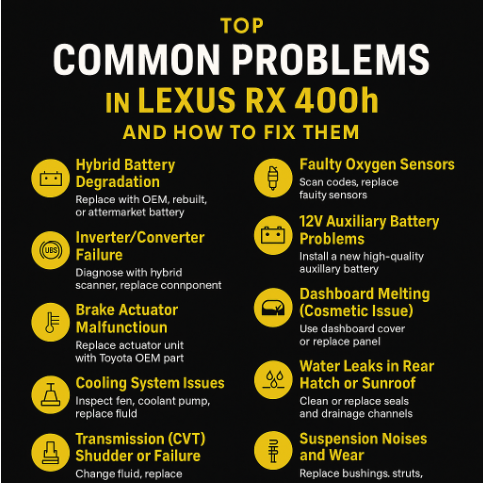
Across the RX400h fleet in the workshop, these are the ten failure modes we see most often, ranked by frequency and financial impact.
1. Hybrid Battery Degradation
Cost to fix: $3,500-$5,000 for aftermarket replacement, up to $8,000+ at a Lexus dealer.
The RX400h uses a 288V nickel-metal hydride battery pack that typically lasts 8 to 12 years in normal use. Every original RX400h battery is now well past this age, so hybrid battery degradation is nearly universal on unreplaced examples.
Symptoms: Fuel economy dropping (from around 8L/100km toward 11 or 12), the “Check Hybrid System” warning appearing, reduced acceleration, the petrol engine running more often at low speeds. Fault codes P0A80 (replace hybrid battery), P0A7F (battery deterioration).
For full details on Check Hybrid System warnings, see our Check Hybrid System warning guide. For replacement options and pricing, see the Lexus RX400h hybrid battery replacement page.
2. Brake Actuator Failure
Cost to fix: $2,500-$4,500 for a rebuilt actuator, up to $6,000+ for new at dealer.
The single most notorious RX400h problem. The hybrid brake actuator (technically the hybrid brake pump and accumulator assembly) fails on a significant portion of RX400h cars. When it fails, the car goes into limp mode, warning lights illuminate across the dashboard, and driving becomes unsafe.
Symptoms: VSC and TRAC OFF warnings, ABS warning, “Brake System” warning, hard brake pedal, growling noise from under the dashboard. Fault codes C1256, C1252, C1201, C1391.
Early symptoms include a slight brake pedal irregularity or an occasional short activation of the internal pump you can hear from the driver’s seat. Ignoring these often ends in a complete failure while driving.
3. Inverter Cooling System Failure
Cost to fix: $400-$800 for coolant service and water pump if caught early, $3,000+ if the inverter itself is damaged.
The RX400h uses a separate cooling loop for the inverter, with its own reservoir and electric water pump. The pump can fail silently, and when it does, the inverter overheats. If caught early, the fix is a new pump and coolant service. If the inverter itself is damaged, the cost climbs dramatically.
Symptoms: Inverter overtemperature warnings, coolant level dropping in the smaller reservoir, the electric pump running noisily or not at all. Fault codes P0A93, P0A94.
Prevention: check the inverter coolant reservoir every service, listen for the electric pump when the car is running.
4. Water Pump Failure (Engine Coolant)
Cost to fix: $400-$800 including labour.
The engine coolant water pump on the RX400h has a mediocre longevity record. Failure usually appears as a slow coolant leak from the front of the engine or a gurgling noise on startup.
Symptoms: Coolant loss, coolant temperature warning, wet residue on the front of the engine block. Not a hybrid-specific problem but a common RX400h failure.
5. VSC/TRAC Warnings and 12V Battery Issues
Cost to fix: Variable, often from $200 for a new 12V battery to $1,500 for wiring repair.
Vehicle Stability Control and Traction Control warnings appear intermittently on high-mileage RX400h models without any obvious mechanical fault. The most common cause is not what most owners think.
The overlooked cause is the 12V auxiliary battery. A weak 12V affects hybrid computers and often produces confusing multi-system warnings that clear when the 12V is replaced. Before spending money on wheel speed sensors or wiring, replace the 12V battery if it is more than 3 years old.
Other causes: wheel speed sensor failure, corroded connectors in the wheel arch wiring, and occasionally a failing yaw rate sensor.
6. Air Conditioning Compressor Failure
Cost to fix: $1,200-$2,500 including labour and refrigerant.
RX400h air conditioning uses an electric compressor driven by the hybrid system rather than a belt-driven compressor. The electric compressor is a specialty part, more expensive than a conventional compressor, and it fails more often on high-mileage RX400h examples than owners expect.
Symptoms: AC blowing warm air, no cooling on hot days, compressor not engaging when AC is turned on, occasionally a fault code linked to the hybrid air conditioning system. On some cars the failure is preceded by a rattling noise from the front of the engine bay when the AC is running.
Replacing with a genuine or high-quality aftermarket part is important on the RX400h because cheap AC compressor rebuilds have a poor reliability record.
7. Dashboard Cracking
Cost to fix: $150-$400 for a dashboard cover, $1,500-$3,000 for a full dashboard replacement.
The RX400h dashboard is prone to developing cracks over time, particularly on the passenger side and around the airbag area. This is a known issue across the Lexus RX and Toyota Highlander family from this era. Sun exposure and interior heat accelerate it, so cars in hot climates see it worse.
Symptoms: Fine cracks appearing on the dashboard surface, then spreading. Not a mechanical problem but a cosmetic one that affects resale value and can occasionally interfere with the passenger airbag deployment path if severe.
Common fix: most owners choose a fitted dashboard cover rather than a full replacement because a full dash swap is labour-intensive.
8. Rear Tailgate Struts Failing
Cost to fix: $80-$200 for a pair of aftermarket struts, including DIY installation.
The gas struts that hold the rear tailgate open weaken over time and eventually cannot hold the tailgate up. Nearly universal on 15+ year old RX400h cars. Minor annoyance, easy fix.
Symptoms: The tailgate slowly closes on its own, will not stay fully open, or feels heavy when lifting. Aftermarket replacement struts are inexpensive and take 15-20 minutes to install with basic tools.
9. Oxygen Sensor and Catalytic Converter Issues
Cost to fix: $300-$600 per oxygen sensor, $1,500-$3,500 for catalytic converter replacement.
At high mileage (200,000km+, 125,000+ miles), the RX400h’s oxygen sensors begin to fail, and in some cases the catalytic converter itself degrades. Failed oxygen sensors trigger fault codes and can cause fuel economy to drop.
Symptoms: Check Engine light with codes in the P0130-P0161 range (oxygen sensor codes), P0420 or P0430 (catalyst efficiency), gradual fuel economy decline, occasional rough idle.
Prevention: using quality fuel and keeping up with engine oil changes extends the life of both the sensors and the catalytic converter.
10. Steering Rack Wear
Cost to fix: $1,500-$3,000 for a rebuilt rack including labour.
At high mileage (200,000km+, 125,000+ miles), the steering rack develops play and often starts to weep power steering fluid. Not a safety-critical issue in early stages but a component that eventually needs attention.
Symptoms: Steering feels loose or vague, occasional whine from the power steering when turning at full lock, wet residue on the front subframe, power steering fluid level dropping between services.
Prevention: flushing the power steering fluid every 5 years reduces the rate of rack wear significantly. Most RX400h owners have never had this done.
Lexus RX400h Fault Codes You Should Know
If your RX400h is showing warning lights, these are the codes most likely to appear:
Hybrid battery codes:
- P0A80 — Replace hybrid battery pack
- P0A7F — Battery deterioration
- P0AFA — Hybrid battery voltage low
Brake actuator codes (the RX400h’s most notorious cluster):
- C1256 — Booster pump problem
- C1252 — Accumulator pressure sensor circuit
- C1201 — Brake control system malfunction
- C1391 — Accumulator low pressure
Inverter and hybrid system codes:
- P0A93 — Inverter cooling system performance
- P0A94 — DC/DC converter performance
- P0A0A — High voltage system interlock circuit
Engine management codes:
- P0130-P0161 — Oxygen sensor faults
- P0420, P0430 — Catalytic converter efficiency
For full explanations, see our hybrid fault code guide. A hybrid-specific diagnostic scan is required to read the C-codes and P0Axx codes reliably. Generic OBD-II scanners often miss them.
What Does It Cost to Keep a Lexus RX400h Running?
Realistic budgeting for an RX400h owner planning to keep the car for the next 3-5 years:
| Repair | Typical cost | Frequency |
|---|---|---|
| Hybrid battery replacement (aftermarket) | $3,500-$5,000 | Once, if not already done |
| Brake actuator (rebuilt) | $2,500-$4,500 | Once, high risk |
| Inverter coolant service and pump | $400-$800 | Every 5-8 years |
| Engine water pump | $400-$800 | 12-15 year interval |
| Air conditioning compressor | $1,200-$2,500 | Once at high mileage |
| Oxygen sensors | $300-$600 each | Every 150,000 km |
| Steering rack (rebuilt) | $1,500-$3,000 | Once at very high mileage |
| Standard servicing (fluids, filters, brakes) | $600-$1,000 per year | Ongoing |
| Tyres | $800-$1,500 per set | Every 60,000-80,000 km |
The three big-ticket items (hybrid battery, brake actuator, AC compressor) determine whether an RX400h is worth keeping. If all three have been recently replaced on the specific car you own or are looking at, the ongoing costs are manageable. If none have been done, budget $7,500-$12,000 for that work sitting in your near future.
How Long Will a Lexus RX400h Last?
An RX400h with completed hybrid battery replacement and completed brake actuator work will typically run reliably to 350,000-400,000 kilometres (220,000-250,000 miles) with normal servicing. The engine and transaxle are among Toyota’s most durable, and most other components are shared with high-volume Toyota models with mature parts supply.
The question is rarely “will the RX400h last” and more often “have the two major repairs already been done, and can the current owner afford them if not.”
Is a Lexus RX400h Worth Buying Today?
The RX400h in 2026 is a specific value proposition: a luxury SUV that can be bought cheaply because of its age, driven for years with modern hybrid economy, and repaired affordably compared to a comparable modern luxury SUV.
Buy an RX400h if:
- The specific car has documented hybrid battery replacement (or you can budget for one)
- The brake actuator has been done, or you accept the risk of doing it
- You want luxury SUV character at a used-car price
- You have a hybrid-competent workshop available
Skip the RX400h if:
- You cannot budget for a $5,000+ repair
- The car has no service history
- The dashboard shows any of the fault codes above and the seller cannot explain them
- You expect zero-repair ownership from a 15+ year old car
Lexus RX400h FAQ
What are the most common problems with the Lexus RX400h?
Hybrid battery degradation, brake actuator failure, inverter cooling system failure, engine water pump failure, VSC/TRAC warnings and 12V battery issues, air conditioning compressor failure, dashboard cracking, tailgate struts, oxygen sensor issues, and steering rack wear. The first three (battery, brake actuator, AC compressor) are the highest-cost items and the most common reasons owners consider selling the car.
What years of the Lexus RX400h should you avoid?
The 2006 is the least reliable year (first-model-year issues, more frequent brake actuator and inverter cooling problems). The 2007 and 2008 are noticeably better. If choosing among RX400h years today, prioritise 2007 or 2008 examples with documented service history over a 2006, unless the 2006 has already had the major repairs done.
Is the Lexus RX400h reliable?
Above average for a 15+ year old luxury hybrid. The engine and transaxle are extremely durable. The weak points are specific and known: brake actuator, hybrid battery, inverter cooling, AC compressor. Owners who address these proactively get long service lives. Owners who ignore warnings often face repair costs that exceed the car’s value.
How many miles will a Lexus RX400h last?
250,000-350,000 miles (400,000-550,000 kilometres) is realistic with proper maintenance and the major known repairs completed. The powertrain rarely limits an RX400h’s life; the cost of replacing worn hybrid, brake, and AC components is what usually determines when owners stop keeping the car.
How much does it cost to replace the hybrid battery in a Lexus RX400h?
$3,500-$5,000 for a new aftermarket pack professionally fitted. Lexus dealer prices run $6,000-$8,000+ for the same job. Reconditioned options are cheaper but shorter-lived. See the Lexus RX400h hybrid battery replacement page for current pricing.
How much does it cost to replace the brake actuator on a Lexus RX400h?
$2,500-$4,500 for a professionally rebuilt actuator. New from Lexus can run $6,000+. Since most rebuilt units use tested components, quality varies significantly between suppliers.
Why did my RX400h VSC and TRAC warnings just appear?
Most often, a weak 12V auxiliary battery. Replace the 12V battery first if it is more than 3 years old, then re-scan for codes. The 12V affects hybrid computers and often triggers confusing multi-system warnings that clear when it is replaced. If the warnings persist after 12V replacement, the next most likely cause is a wheel speed sensor.
Can you drive a Lexus RX400h with the Check Hybrid System warning on?
Sometimes yes, sometimes no. If the car drives normally and the warning is on, most short trips are safe. If the car enters limp mode, shows brake warnings, or reduces power dramatically, stop driving and arrange a diagnostic. See our Check Hybrid System warning guide for detailed guidance.
What is the fuel economy of a Lexus RX400h?
Typically 8-9L/100km (26-29 mpg US, 31-35 mpg UK) with a healthy hybrid system. If the battery is degrading, economy drops to 10-12L/100km (20-24 mpg US) or worse, which is the first sign owners usually notice before the warning lights appear.
Is the Lexus RX400h the same as the Toyota Highlander Hybrid?
Mechanically very similar. Both use the same hybrid drivetrain and share many components. The differences are luxury-oriented (interior, trim, badge, price when new). For repair purposes, workshops competent on Highlander Hybrid are typically competent on RX400h.
Is buying a used Lexus RX400h in 2026 a good idea?
Yes, if you understand the specific risks. An RX400h is now cheap to buy, expensive to fix, and reliable in between. If the major repairs have been done, it is one of the best-value luxury SUVs on the used market. If they have not been done and you cannot afford to do them, choose a different car.
Get Your Lexus RX400h Assessed
If you own an RX400h and are seeing warning lights, fuel economy changes, or brake system quirks, a proper diagnostic is usually cheaper than guessing. We assess RX400h hybrid batteries, brake systems, and inverter cooling at our Belmore workshop in Sydney, or via freight to your local mechanic anywhere in Australia.
If your hybrid battery specifically needs replacement, our aftermarket RX400h hybrid battery replacement is fitted with a 2 year / 100,000 km warranty and typically saves $3,000-$4,000 versus dealer pricing.
Call 0493 688 444 or book online.