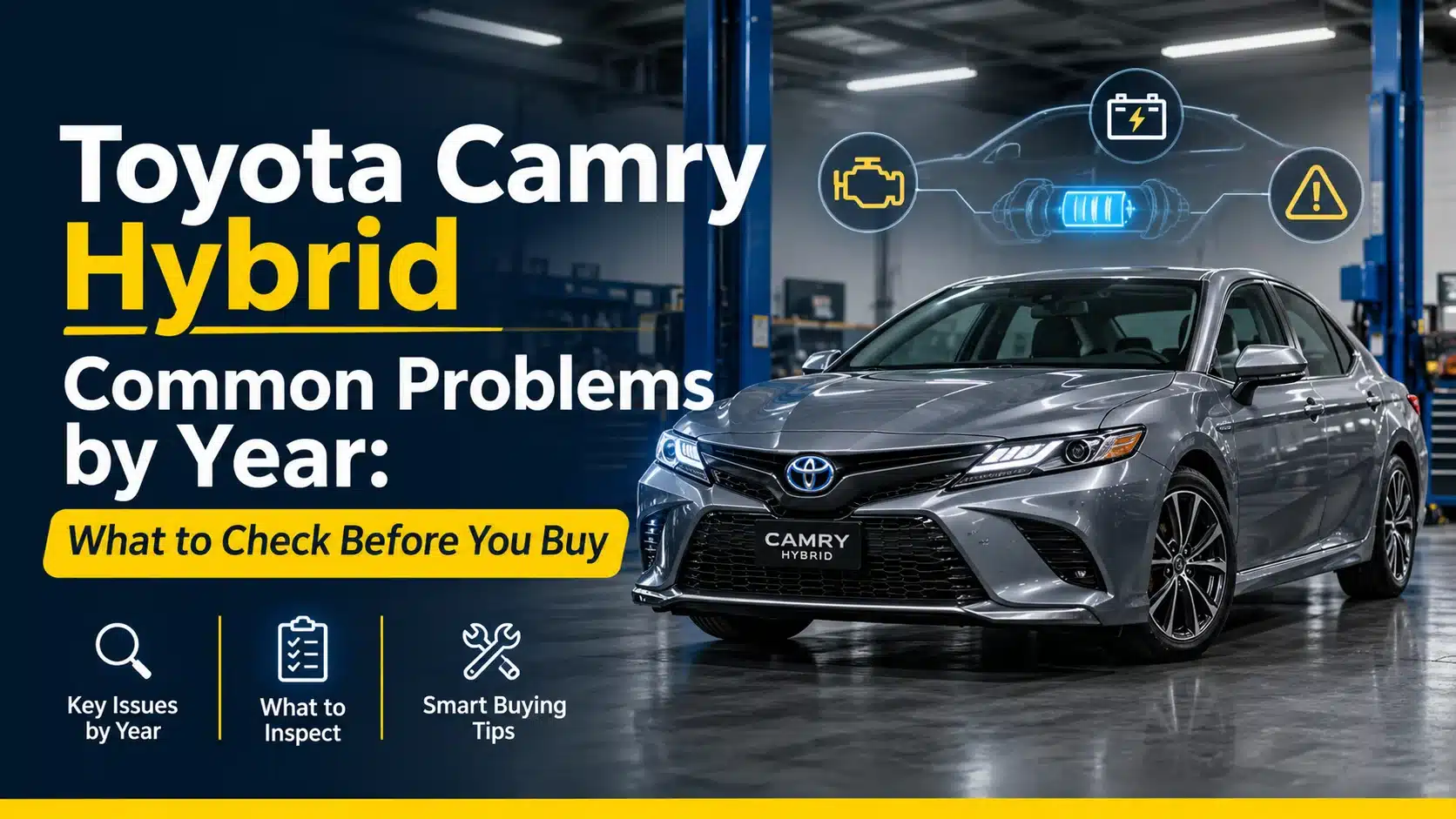
Toyota Camry Hybrid Common Problems by Year: What to Check Before You Buy
The generation matters more than the mileage. A 2013 Camry Hybrid with 180,000 km on its original NiMH battery is a different proposition from a 2021 with lithium-ion and half the kilometres — and neither one shares the same failure patterns as the 2007 that put brake actuator complaints on the map. If you’re shopping for a used Camry Hybrid in Australia, the model year tells you which engine sits under the bonnet, which battery chemistry is in the pack, and which problems are worth worrying about versus which ones the internet has blown out of proportion.
We service Toyota and Lexus hybrids at our Belmore workshop every day. The Camry Hybrid is the car we see most — it’s been Australia’s best-selling hybrid sedan for over a decade, and roughly 70 percent of the ones on Australian roads started life as taxis or fleet vehicles. That fleet history isn’t necessarily bad news, but it does mean high-mileage examples are common and certain wear items come up earlier than they would on a suburban school-run car.
Here’s what actually goes wrong with the Toyota Camry Hybrid, generation by generation, based on what we see on our hoists and what the recall data confirms.
2007–2011: The First Generation (XV40)
This was the one that proved a Camry could run a hybrid drivetrain reliably enough for taxi fleets to adopt it across Australia. Toyota built these locally at Altona, Victoria. The powertrain pairs a 2AZ-FE 2.4-litre four-cylinder with Toyota’s second-generation Hybrid Synergy Drive, running through a 244.8-volt nickel metal hydride battery pack made up of 34 modules with six cells each.
For a car that launched nearly two decades ago, plenty are still on the road. But this generation has the highest complaint count of any Camry Hybrid, and three issues dominate.
The brake actuator problem
This is the big one — 391 safety complaints to NHTSA for the 2007 model year alone, the vast majority about brakes.
A Camry Hybrid doesn’t brake like a conventional car. When you press the pedal, pressure sensors inside the brake actuator assembly measure your input. The ABS ECU reads that demand, then asks the hybrid control ECU — over the vehicle’s CAN network — how much regenerative braking the electric motor can provide. Whatever the motor can’t cover, the actuator fills in with hydraulic pressure from its own internal pump and accumulator. Eight solenoid valves modulate pressure to each wheel independently.
Over time, those internal solenoid valves stick, the pump motor wears, or the ECU develops faults. You’ll see ABS, VSC, and brake warning lights — sometimes all at once. Common fault codes are C1252, C1253, and C1256.
What happens when the actuator fails
The system does fail safely. The master cylinder cut solenoids are designed “normally open,” so a total electrical failure reconnects your pedal directly to the callipers through a conventional hydraulic path. You won’t lose braking entirely — but you lose anti-lock function, stability control, and most power assist. Pedal effort climbs dramatically. For someone who doesn’t expect the change, that’s genuinely dangerous.
NHTSA investigated under inquiry PE14-001 but never ordered a recall. No Australian safety recall was issued either. Replacement runs $3,000 to $5,500 in Australia depending on new versus remanufactured, and the new unit requires calibration through Toyota’s Techstream — the linear solenoid valves must be “learned” to the vehicle before the system operates normally.
One important note: fault code C1300, which looks like an actuator failure, is frequently triggered by a weak 12-volt auxiliary battery. Always check the 12V first.
2AZ-FE oil consumption
The 2.4-litre engine in these early Camry Hybrids shares the same oil-burning defect that plagued the conventional Camry and RAV4 of the same era. The oil return holes behind the oil control piston rings are undersized in the original design. Over time, carbon deposits block those holes, oil can’t drain back to the crankcase, and it gets burned in the combustion chamber instead.
Consumption rates of one litre every 1,000 to 1,500 kilometres aren’t unusual. Some owners reported far worse. The onset tends to appear between 70,000 and 100,000 km.
Toyota acknowledged this with TSB MC-10134187-9999 (an inspection procedure) and a Warranty Enhancement Program that covered piston and ring replacement with revised parts featuring larger oil return holes. In Australia, Toyota offered what it called “considerable product support beyond warranty” on a case-by-case basis, though the programme wasn’t as straightforward as the US version.
The honest answer: if you’re looking at a first-generation Camry Hybrid and the seller says it doesn’t use oil, verify that yourself. Check the dipstick at purchase, then again after 1,000 km. Revised pistons are the only permanent fix. No additive or oil change interval genuinely solves it.
Dashboard deterioration
In Australian conditions — and this is genuinely a hot-climate problem — the dashboard material on these cars degrades. It becomes soft, sticky, and reflective. The reflected glare off a melted dashboard onto the windscreen is a real visibility hazard, not just cosmetic.
Toyota ran a Warranty Enhancement Program in the US that replaced dashboards and reimbursed owners US$1,600 if they’d already paid for the repair. In Australia, the response was slower. Toyota eventually offered free replacement parts for confirmed heat-and-humidity damage, though some owners were asked to cover labour. No formal safety recall was issued here.
What to check before buying a 2007–2011
Pull the fault codes with a hybrid-capable scan tool — not a generic OBD2 reader. You need one that reads hybrid-specific and ABS codes. Check specifically for any C-series brake codes. Test the 12V battery voltage with the car off (should be above 12.4V). Check oil level at inspection, note it, and recheck after a test drive. Look at the dashboard surface in direct sunlight for any tackiness or sheen. Ask about the hybrid battery — at this age and in Australian conditions, original packs are well past their expected life. A battery health assessment before purchase can save you from a $6,000–$10,000 surprise.
2012–2017: Second Generation (XV50)
Toyota moved to the 2AR-FXE 2.5-litre engine for this generation, still paired with a NiMH battery pack and THS II hybrid drive. These are the last Camry models built at the Altona plant before Australian manufacturing ended in 2017. You’ll find plenty of ex-fleet and ex-taxi examples with 250,000+ km on the clock.
This generation is generally more reliable than the first, but it introduced a problem that still catches buyers off guard almost every week at our workshop.
The 12-volt battery misdiagnosis
This is the single most common issue we see across all Camry Hybrid generations, and it’s worst on the XV50 because so many of them are now at the age where the 12V battery has been replaced once or twice by someone who fitted a cheap unit.
Here’s what you need to understand: a Camry Hybrid has two completely separate batteries. The high-voltage NiMH (or later lithium-ion) pack powers the electric drive motor. The small 12-volt auxiliary battery — tucked in the boot, not under the bonnet — powers every electronic control module in the vehicle, including the one that connects the high-voltage battery to the rest of the drivetrain.
When the 12V drops below roughly 11 volts, the hybrid system can’t initialise. The contactors that bridge the high-voltage pack to the inverter won’t close. The car throws a “Check Hybrid System” warning, and in many cases simply won’t start. The owner panics, searches online, and concludes the hybrid battery is dying. They get quoted $8,000 to $10,000 for a new HV pack.
In reality, it’s often a $200 auxiliary battery.
The 12V battery in a Camry Hybrid is physically smaller than in a conventional car — typically a Group S46B24R AGM — because it doesn’t need to crank a starter motor. MG1 (the motor-generator integrated into the hybrid transaxle) handles engine starting. But that smaller battery means less reserve capacity, and in Australian summers, battery life drops to three to four years. Aftermarket dashcams and GPS trackers wired to constant power make it worse.
Our advice: if you see a “Check Hybrid System” warning, test the 12V battery first. Every time. We do this before any other diagnostic step.
The transmission confusion
You’ll find plenty of articles online listing “transmission hesitation” and “torque converter shudder” as 2012–2017 Camry problems. That’s accurate for the conventional petrol Camry with the six-speed automatic. It does not apply to the Camry Hybrid.
The Camry Hybrid doesn’t have a conventional gearbox. It uses an electronically controlled continuously variable transmission — a planetary gear set with two motor-generators (MG1 and MG2) that vary the effective gear ratio seamlessly. There is no torque converter. There are no physical gear changes to hunt or shudder.
What some Camry Hybrid owners describe as “hesitation” is typically the transition between pure electric drive and the petrol engine kicking in. The power-split device manages this handoff, and in the XV50 it’s occasionally not seamless — a brief stumble as the engine fires and the system rebalances. Toyota issued ECM software updates to smooth this transition. It’s a calibration issue, not a mechanical one, and it doesn’t indicate component failure.
If you’re test-driving an XV50 Camry Hybrid and feel a momentary stumble when the engine starts from electric-only mode, that’s what you’re feeling. If you feel a rhythmic shudder at highway speed, that’s a different problem and warrants investigation — but it’s rare on the hybrid.
Inverter coolant: the maintenance item nobody knows about
The hybrid inverter — the component that converts DC from the battery to AC for the motor — has its own dedicated cooling loop. Completely separate from the engine coolant. Different reservoir, different circuit, different drain point.
The inverter’s heat sink is a large aluminium block with dozens of narrow internal passages. When the coolant in this loop degrades (pH drops, corrosion inhibitors deplete), those passages corrode and restrict. The inverter runs hotter. Eventually, it overheats and triggers fault codes or derates the hybrid system.
Toyota’s maintenance schedule calls for inverter coolant replacement at 160,000 km or 10 years, whichever comes first. But most owners — and plenty of general mechanics — don’t know this loop exists. We’ve seen cars come in for hybrid system faults where the inverter coolant has never been touched in 12 years. The drain plug sits close to the transmission fluid drain and looks similar, which adds to the confusion.
If you’re buying a used XV50 and the seller can’t confirm inverter coolant has been replaced, factor that into your maintenance plan. It’s a relatively inexpensive service (under $300) but the consequences of skipping it are expensive.
What to check before buying a 2012–2017
Test the 12V battery — not just “does it start,” but measure the actual voltage and check for parasitic draw. Ask whether the inverter coolant has ever been replaced and look for a receipt. Run a hybrid battery health scan to check individual cell voltages (NiMH cells should be closely balanced — more than 0.3V spread between the weakest and strongest cell suggests degradation). Check for AC evaporator leaks — turn the climate control to max cold and sniff for a sweet chemical smell from the vents, which indicates refrigerant leak. Evaporator replacement requires removing the dashboard, so it’s a $1,500 to $2,500 job.
2018–2020: Third Generation, Early TNGA Years (XV70)
This is where the Camry Hybrid took a significant step forward. Toyota moved to the TNGA-K platform with a new A25A-FXS 2.5-litre Dynamic Force engine — a fundamentally different engine from the 2AR-FXE. The hybrid system moved to a fourth-generation THS II with higher thermal efficiency (41 percent, which was a benchmark at the time).
The hybrid battery chemistry also began to change. Australian-delivered Camry Hybrids used NiMH through most of 2020, then switched to lithium-ion from August 2020. If you’re buying in this range, check whether the car has NiMH or Li-ion — the VIN and build date will confirm it. Li-ion is lighter, charges faster, and degrades more slowly.
There’s also less to worry about mechanically. The 2AZ-FE oil consumption problem is gone — the A25A-FXS uses a different piston design, laser-clad valve seats, and a longer stroke ratio. The brake actuator complaints dropped significantly with the new platform. But this generation introduced a couple of issues worth knowing about.
The 2020 engine block casting defect
This one is serious and applies to a narrow production window. Certain 2020 Camry and RAV4 models — both hybrid and conventional — were built with engine blocks containing tiny air pockets in the aluminium casting. These voids can create internal coolant passages where none should exist, allowing coolant to leak into the oil galleries or externally.
Symptoms start subtle: a slight drop in coolant level with no visible leak, a faint sweet smell, or an unexplained rise in engine temperature. Left unchecked, the engine can overheat severely. Oil contamination from internal coolant mixing will destroy bearings.
NHTSA issued recall campaign 20V064 covering approximately 44,000 vehicles in the US. Toyota Australia issued its own corresponding recall. The remedy is either a complete engine assembly replacement or a short block replacement, depending on the specific engine block casting number — which a dealer checks by photographing a 12-character stamping under the engine.
If you’re looking at a 2020 Camry Hybrid, confirm whether the recall has been completed. A VIN check through Toyota Australia’s recall portal or by calling the Recall Campaign Helpline (1800 987 366) will tell you.
Fuel pump recall (2019 production vehicles)
Denso-manufactured low-pressure fuel pump impellers in a specific production run can deform over time, reducing fuel delivery to the point where the engine stalls. This was part of a massive global recall across multiple Toyota and Lexus models.
In Australia, Toyota recalled approximately 2,010 Camry Hybrid vehicles produced between 14 March and 31 May 2019. The fix is a fuel pump replacement at no cost, taking about an hour and a half. Again, a VIN check confirms whether a specific car was affected and whether the recall work was done.
Infotainment quirks
Screen blackouts and Apple CarPlay disconnections showed up frequently in owner forums for 2018–2020 models. These are software issues, generally resolved through dealer updates. Not a deal-breaker, but if you’re test-driving and the screen freezes or CarPlay drops, ask the dealer whether the latest software version is installed.
EGR valve carbon buildup
The A25A-FXS can develop carbon deposits on the EGR (exhaust gas recirculation) valve pintle, particularly in cars that do lots of short trips. In a hybrid, the petrol engine cycles on and off constantly — it may run for two minutes, shut down for a kilometre of electric driving, then restart. Those short run cycles sometimes don’t bring the EGR system to full operating temperature, which allows carbon to accumulate.
Fault codes P0401 through P0403 point here. Cleaning or replacing the valve is a straightforward repair, but if you see an engine light on a test drive, it’s worth pulling the codes before assuming it’s something more expensive.
What to check before buying a 2018–2020
Confirm whether the 2020 engine block recall (20V064) and the 2019 fuel pump recall have been completed — VIN check through Toyota Australia. Ask for the battery chemistry (NiMH or Li-ion) and note the build date. Check infotainment responsiveness during the test drive. Listen for any unusual engine roughness that might indicate EGR buildup. And still test that 12V auxiliary battery — this generation moved it under the bonnet on some variants, but the same degradation rules apply.
2021–2024: The Lithium-Ion Era (XV70 Facelift)
From 2021, every Camry Hybrid sold in Australia comes with a lithium-ion battery pack. That’s a meaningful upgrade — Li-ion is lighter, more energy-dense, charges and discharges more efficiently, and based on early data appears to degrade more slowly than the NiMH packs in earlier generations. The battery also moved from the boot to under the rear seat, improving cargo space and weight distribution.
Mechanically, this is the same TNGA platform and A25A-FXS engine as the 2018–2020, with the major drivetrain issues largely resolved through running production changes. The problems that do show up are mostly electrical and software-related.
Digital instrument display failure
Toyota Australia recalled 69,586 vehicles across multiple models — including the Camry Hybrid — for a software defect in the 12.3-inch digital instrument cluster. The affected production period runs from approximately July 2022 to April 2025.
The root cause is oddly specific: the instrument cluster software writes unnecessary data to an internal memory chip on a repeated loop. Over time, this degrades the memory until the display can’t load at startup. You turn the car on and get a blank screen where your speedometer, fuel gauge, and warning lights should be.
The vehicle is still drivable — the engine and hybrid system operate normally — but driving without a speedometer or warning indicators is obviously not ideal. The fix is a free software update at any Toyota dealer, taking one to two and a half hours.
If you’re buying a 2022–2024 Camry Hybrid, ask whether this recall has been completed. The VIN-specific lookup through Toyota Australia will confirm it.
12V battery drain (still)
The same issue. More electrical accessories in newer models — larger infotainment screens, more sensors, smart entry systems — mean more parasitic draw on the 12V battery when the car is parked. If a 2021+ Camry Hybrid sits unused for two to three weeks, the smart entry system alone can flatten the auxiliary battery.
Not a defect as such, but worth knowing if the car will sit in your driveway for extended periods between uses. A trickle charger is cheap insurance.
What to check before buying a 2021–2024
Instrument display recall status. 12V battery health. Otherwise, these are genuinely solid cars. The combination of the proven A25A-FXS engine, lithium-ion battery, and TNGA platform makes the 2021–2024 Camry Hybrid one of the more trouble-free options in the used hybrid market.
2025–2026: The Hybrid-Only Generation (XV80)
From 2025, there is no conventional petrol-only Camry. Every Camry sold worldwide is a hybrid. This is a new-generation car on an updated TNGA platform with fresh styling inside and out, and it’s too early for a meaningful reliability track record. But early data already shows one issue worth flagging.
Inverter bolt recall (Campaign 25V869)
In December 2025, NHTSA issued recall campaign 25V869000 covering 55,405 vehicles in the US — mostly 2025–2026 Camry Hybrids and some 2026 Corolla Cross Hybrids. The supplier, Denso Manufacturing Tennessee, traced the cause to a machine setting change during a specific production window (late August to late November 2025).
A bolt inside the hybrid motor control inverter may have been under-torqued during assembly. If it loosens, it can fall onto the inverter’s circuit board. An open circuit triggers a “Hybrid System Malfunction” warning and can cause loss of motive power — which at highway speed is a serious safety concern. A short circuit from the loose bolt contacting the board creates an overheating and potential fire risk.
Toyota’s interim guidance was blunt: “Do Not Drive. Park Outside.” A permanent repair was pending as of early 2026.
Australian recall status for this campaign should be checked through Toyota Australia directly, as the production source and affected VIN ranges may differ from the US market.
Early software and sensor complaints
Higher-than-average complaint volumes are appearing for the 2025 and 2026 model years, mostly around electrical systems, the combination meter display, and sensor calibration. This is typical for a first-year redesign — new vehicle platforms almost always have a higher complaint rate in year one that drops as production quality stabilises and software updates roll out.
What to check before buying a 2025–2026
Confirm whether the inverter recall applies to the specific VIN and whether it’s been remedied. Keep in mind that permanent-fix availability may still be rolling out. Check for any software updates that have been released since the car was built. And recognise that with a car this new, the service history is thin — you’re relying more on Toyota’s warranty coverage (check the specific terms for your purchase date) than on a track record.
The used Camry Hybrid buyer’s checklist (any generation)
Some things apply regardless of model year.
Always test the 12V battery first.
Before any other diagnostic step. A weak 12V battery can trigger “Check Hybrid System” warnings, ABS/VSC lights, no-start conditions, and fault codes that mimic far more expensive problems. We test the 12V battery on every Camry Hybrid that rolls into our workshop before we open a scan tool.
Get a hybrid-specific battery health assessment.
A generic OBD2 reader won’t tell you what you need to know. A proper assessment checks individual cell voltages across the entire pack. On NiMH batteries (pre-2021), look for voltage spread between the weakest and strongest cells — more than 0.3V difference suggests a pack that’s degrading. On lithium-ion (2021+), the cells tend to stay more tightly balanced, but capacity fade is still measurable.
Check the recall history by VIN.
Every generation has at least one recall campaign. Toyota Australia’s recall helpline (1800 987 366) or your dealer can confirm which recalls apply and whether the work has been completed.
Ask about the inverter coolant.
If the car is a 2012 or newer with more than 150,000 km and the owner can’t show you an inverter coolant service receipt, budget for it. The service itself is under $300, but the damage from a blocked inverter heat sink isn’t.
Consider remanufactured battery packs.
If the high-voltage battery does need replacement, you’re not limited to a brand-new Toyota pack at $8,000 to $10,000. Australian remanufacturers like Injectronics restore NiMH packs to original cell performance specifications with a two-year guarantee, at roughly 60 to 80 percent of the new price. That’s a $2,000 to $3,000 saving. Our workshop offers aftermarket, OEM, and refurbished options with a 24-month warranty — we’ll walk you through the tradeoffs for your specific car.
Don’t confuse hybrid problems with conventional Camry problems.
The internet is full of articles that lump all Camry issues together. The eight-speed automatic transmission complaints, the torque converter shudder, the non-hybrid engine issues — those are for the conventional petrol Camry. The Camry Hybrid uses an entirely different drivetrain with an eCVT (a planetary gear set and two motor-generators). It doesn’t have gears to hunt. It doesn’t have a torque converter to shudder. Make sure the “known problems” you’re reading about actually apply to the hybrid variant.
Common questions
What does “Check Hybrid System” mean?
It means the hybrid control module has detected a fault somewhere in the high-voltage system — but the most common trigger isn’t actually a hybrid system problem. A weak 12V auxiliary battery, a blown fuse, or a loose connector can all throw this warning. Before assuming the worst, get the 12V battery tested and pull the specific fault codes with a hybrid-capable scanner. The code narrows it down; the warning light on its own doesn’t tell you enough.
Is the Camry Hybrid reliable enough to buy used?
Yes — with caveats that depend on the year. The 2007–2011 generation has known brake actuator and oil consumption issues that make a pre-purchase inspection essential. The 2012–2017 is more reliable but watch for the 12V battery and inverter coolant. The 2018+ on the TNGA platform is a genuinely excellent car, with the main risks being model-year-specific recalls that a VIN check resolves. In our experience, more Camry Hybrids leave our workshop with a minor fix than a major one.
Can I service a Camry Hybrid at any mechanic?
Routine maintenance — oil changes, brake pads, filters — yes. But hybrid-specific work (battery diagnostics, inverter service, brake actuator replacement, high-voltage system repairs) requires a workshop with the right training, tooling, and safety protocols. High-voltage systems carry serious shock risk if handled incorrectly. We’d recommend any hybrid-specific service or diagnosis go to a specialist.
What’s the difference between NiMH and lithium-ion in a Camry Hybrid?
NiMH (nickel metal hydride) was used in the Camry Hybrid from 2007 through most of 2020 in Australia. Lithium-ion replaced it from August 2020 (2021 model year onward). Li-ion is lighter (better fuel economy), charges and discharges more efficiently (better throttle response), and early data suggests slower capacity fade over time. The tradeoff was originally cost — Li-ion packs are more expensive to replace — but that gap has narrowed. For a used buyer, Li-ion is the preferred chemistry if budget allows.
What year Camry Hybrid should I avoid?
The 2007 model year has the highest complaint count of any Camry Hybrid generation — brake actuator failures alone account for hundreds of reports. The 2008 and 2009 share the same actuator design and the worst of the 2AZ-FE oil consumption problem. A 2020 from the wrong production window may carry the engine block casting defect (check recall status by VIN). Every other model year is generally solid, with the 2014–2017 and 2021–2024 ranges being particularly trouble-free. Rather than avoiding an entire year, the smarter move is checking the specific car’s recall history and getting a hybrid-specific inspection before buying.
Does the Toyota Camry Hybrid have transmission problems?
No — and this is one of the most common mix-ups online. The conventional petrol Camry uses a six-speed or eight-speed automatic gearbox, and those do have documented torque converter shudder and gear-hunting complaints. The Camry Hybrid uses an entirely different system: an eCVT with a planetary gear set and two motor-generators. There is no torque converter and no physical gear changes. The occasional stumble some owners feel is the transition from electric-only driving to the petrol engine firing — a calibration issue Toyota has addressed with software updates, not a sign of mechanical failure.
We’re here if you need a second opinion
If you’re considering a used Camry Hybrid and want to know exactly what condition the battery, brakes, and hybrid system are in before you commit, our team at Hybrid Automotives can help. We offer hybrid battery assessments, full diagnostic scans, and honest advice on whether a specific car is worth buying or walking away from. We service Toyota and Lexus hybrids at our Belmore workshop in Sydney, with parts delivery available Australia-wide. Call us or book a consultation online.