
How to Identify and Fix the “Check Hybrid System” Warning in Toyota Aqua
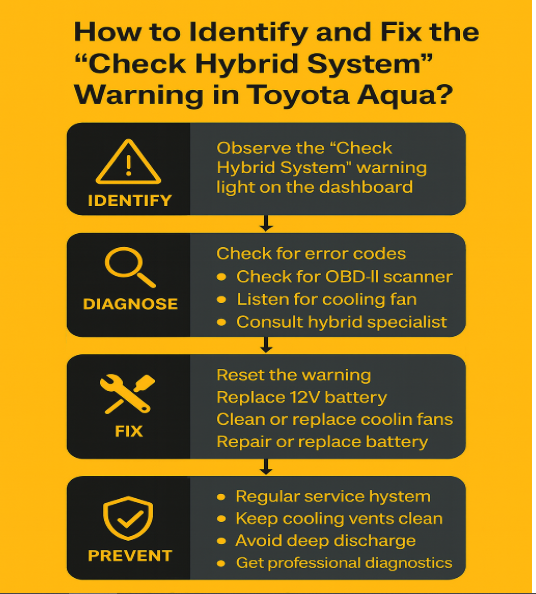
If you drive a Toyota Aqua, you may have seen the dreaded “Check Hybrid System” warning appear on your dashboard. This alert can be concerning, especially if it happens while driving. In this article, we’ll explain what this warning means, the common causes, how to identify the problem, and the best solutions available. Identify and Fix the “Check Hybrid System” Warning in Toyota Aqua At Hybrid Automotive Service, we specialize in Toyota and Lexus hybrid battery replacement across Sydney and NSW. Here’s everything you need to know. What Does the “Check Hybrid System” Warning Mean? The “Check Hybrid System” warning in a Toyota Aqua indicates that something is wrong with the hybrid system, which includes the high-voltage battery, inverter, sensors, and the ECU (engine control unit). When this light comes on, the car may switch to limp mode, reduce power output, or in some cases, stop running. Ignoring the warning can lead to more expensive repairs down the road. Common Causes of the Warning in Toyota Aqua Several issues can trigger the warning light, but the most frequent ones include: 1. Weak or Failing Hybrid Battery A deteriorating hybrid battery is the number one reason for this error. The Toyota Aqua uses a nickel-metal hydride (Ni-MH) pack that typically lasts 7–10 years. 2. Faulty Inverter or Converter The inverter manages the flow of power between the battery and electric motor. If it overheats or fails, the hybrid system will show an error. 3. Cooling Fan Blockage or Malfunction Blocked air vents or a faulty cooling fan can cause the battery to overheat, triggering the warning. 4. Low 12V Auxiliary Battery Even though the Aqua is a hybrid, the 12V battery plays an important role. If it is weak, the system may malfunction. 5. Sensor or ECU Faults A failed sensor or corrupted ECU data can also result in the error message. How to Identify the Issue (Step-by-Step Diagnosis) If you see the warning, here’s how you can begin diagnosing: Check with an OBD-II Scanner – Plug in a scanner to read hybrid system error codes. Inspect the 12V Battery – Test its voltage and replace it if weak. Listen for Cooling Fan Noise – If the fan isn’t running properly, airflow may be blocked. Look for Performance Drops – Lower fuel economy or reduced acceleration can signal battery degradation. Consult a Hybrid Specialist – Professional scans can pinpoint inverter, ECU, or battery faults. Fixing the “Check Hybrid System” Warning Depending on the diagnosis, here are the possible fixes: Resetting the Warning (Temporary Fix) In some cases, resetting the ECU clears the warning, but it usually comes back if the issue isn’t resolved. Replacing the 12V Battery A simple replacement of the auxiliary battery can solve the problem if that’s the root cause. Cleaning or Replacing Cooling Fans Blocked cooling vents should be cleaned, and faulty fans replaced to prevent overheating. Hybrid Battery Repair vs. Replacement If the hybrid battery is weak, you can either: Recondition the battery (short-term solution). Replace the battery (long-term fix, highly recommended). Professional Hybrid System Repair For inverter, ECU, or wiring faults, professional service is essential. Toyota Aqua Hybrid Battery Replacement Options in Sydney At Hybrid Automotive Service, we offer three options for Aqua hybrid battery replacement: Brand New OEM Battery – Original Toyota quality with full reliability. Rebuilt / Reconditioned Battery – Affordable option with limited warranty. Aftermarket Battery – High-quality replacement at a lower cost. All our replacements include professional installation and warranty. Preventing the Warning in the Future To reduce the risk of seeing the warning again: Service your hybrid system regularly. Keep cooling vents clean and free from dust. Avoid fully draining the battery. Get an annual hybrid diagnostic check from a professional.
Lexus CT 200h Not Starting? Troubleshooting Guide for Owners
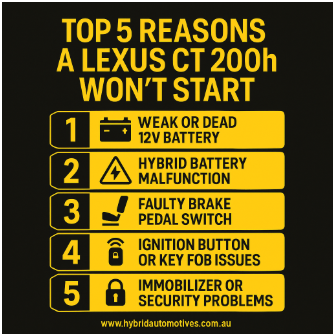
If your Lexus CT 200h won’t start, you’re not alone. While Lexus hybrids are known for their reliability, they have a unique starting process compared to petrol cars — and that means the causes of a no-start issue can be different. In this guide, we’ll walk you through the most common reasons your CT 200h might not start, simple troubleshooting steps you can try, and when to call in a professional. Understanding the Lexus CT 200h Starting System The Lexus CT 200h uses two batteries: A 12V battery to power electronics, computers, and the hybrid system relays. A high-voltage hybrid battery to power the electric motor. Unlike conventional cars, the 12V battery does not crank an engine — it powers the computers that activate “Ready” mode. If the “Ready” light doesn’t appear on your dashboard, the hybrid system won’t engage, and the car won’t move. Common Reasons Your Lexus CT 200h Won’t Start 1. Weak or Dead 12V Battery Symptoms: No “Ready” light. Dim or flickering dashboard lights. Unresponsive electronics. Causes: Age (most 12V batteries last 3–5 years). Leaving the car unused for long periods. Interior lights left on. 2. Hybrid Battery Malfunction While less common, a failed or severely discharged Lexus CT200H Hybrid Battery can stop the car from starting. Signs: “Check Hybrid System” warning. Stored codes like P0A80. Car won’t enter “Ready” mode even after jump-starting the 12V battery. 3. Faulty Brake Pedal Switch The CT 200h won’t start unless the brake pedal sensor confirms the brake is pressed. Tip: Try pressing the brake pedal firmly before pressing the Start/Stop button. 4. Ignition Button or Key Fob Issues A dead key fob battery can prevent the car from recognising the smart key. Try holding the fob against the Start button or replace the fob battery. 5. Immobilizer or Security System Problems If the immobilizer doesn’t detect the correct key, the car won’t start. Look for a flashing security light on the dashboard. 6. Electrical or ECU Faults Faulty sensors or control modules can prevent the hybrid system from starting. Diagnosis requires an OBD2 scan tool or Toyota Techstream software. Step-by-Step Troubleshooting Checklist Check the 12V Battery Voltage – It should read at least 12.4V at rest. Try a Jump Start – Use the CT 200h’s under-bonnet jump start terminal in the fuse box. Replace the Key Fob Battery – Especially if the dash doesn’t respond. Press the Brake Firmly – Ensure the brake pedal switch is detected. Look for Dashboard Warning Lights – Hybrid system warnings require diagnostics. Scan for Fault Codes – Use an OBD2 scanner to identify issues before replacing parts. Preventing Future No-Start Problems Drive Regularly – Keeps the 12V battery charged. Use a Battery Maintainer – If parking the car for more than 2 weeks. Service the Hybrid Battery – Maintain cooling fans and perform health checks. Carry Spare Key Fob Batteries – Cheap and avoids emergency lockouts. When to Seek Professional Help If your CT 200h still won’t start after these checks, it’s time to call a hybrid specialist. They can: Test the hybrid battery under load. Run full diagnostics with Techstream. Repair or replace faulty electrical components.
Do Hybrid Cars Produce More CO2 Than Electric Vehicles? The Truth Explained
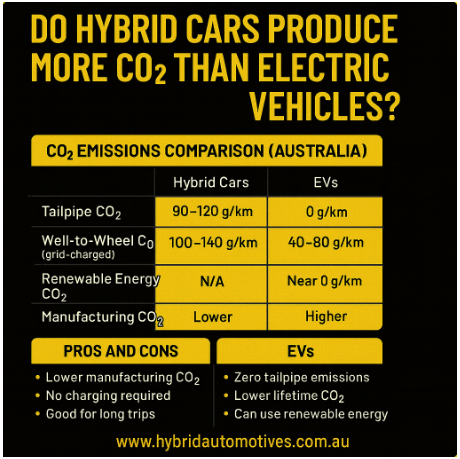
With fuel prices climbing and climate concerns growing, more Australians are weighing up the environmental impact of their next car purchase. One question often asked is: Do hybrid cars produce more CO2 than electric vehicles (EVs)? The short answer is yes — over the long term, EVs generally produce less CO2 than hybrids, especially when charged with renewable energy. However, the full picture depends on how the vehicles are used, how they are charged, and where they are driven. This guide compares tailpipe, well-to-wheel, and life-cycle CO2 emissions for hybrid and electric vehicles in Australia, so you can make an informed choice. Understanding Vehicle Emissions Tailpipe Emissions Hybrid cars: Use both a petrol engine and an electric motor, meaning they still emit CO2 when the engine runs. Typical Australian hybrid tailpipe emissions range from 90–120 g/km. Electric vehicles (EVs): Produce zero tailpipe emissions — no exhaust pipe, no direct CO2 output while driving. Well-to-Wheel Emissions Tailpipe emissions don’t tell the whole story. Well-to-wheel emissions factor in the CO2 released during fuel production and electricity generation. In Australia, EVs charged from the current energy grid produce ~40–80 g/km due to the country’s fossil fuel-heavy electricity mix. Hybrids burn petrol, so their well-to-wheel emissions are typically higher unless the EV is charged from non-renewable sources 100% of the time. Hybrid Cars vs EVs: CO2 Comparison in Australia Metric Hybrid Cars Electric Vehicles (EVs) Tailpipe CO2 90–120 g/km 0 g/km Well-to-Wheel CO2 100–140 g/km 40–80 g/km (grid-charged) Renewable Energy CO2 N/A Near 0 g/km Manufacturing CO2 Lower Higher (due to battery production) Impact of Renewable Charging When EVs are charged with solar power or a renewable-rich grid, their CO2 emissions drop to near zero in operation. This gives them a significant long-term advantage over hybrids. Life-Cycle Emissions: From Manufacturing to Disposal Manufacturing Phase EV batteries require significant mining and processing of lithium, cobalt, and nickel, making their production CO2 footprint higher than that of hybrids. Hybrids have smaller batteries and therefore lower manufacturing emissions. Break-Even Point Studies show EVs in Australia typically overtake hybrids in lifetime CO2 savings after 2–4 years of average driving, depending on charging habits. Pros and Cons: CO2 Perspective Hybrid Pros Lower CO2 footprint during manufacturing. No need for charging infrastructure. Good for regional travel without charging stops. Cons: Ongoing CO2 emissions while driving. Less effective for long-term emissions reduction. EV Pros Zero tailpipe emissions. Much lower lifetime CO2 when charged with renewables. Potential for full carbon neutrality with clean charging. Cons: Higher initial manufacturing CO2. Dependent on Australia’s electricity grid for CO2 benefits. Which is Better for Australia Right Now? City drivers with solar panels → EVs win for CO2 reduction. Regional drivers without charging access → Hybrids may be more practical. Mixed-use drivers → Plug-in hybrids (PHEVs) could offer the middle ground.
Self-Charging Hybrid or Plug-In Hybrid: What’s Better for Australian Drivers?
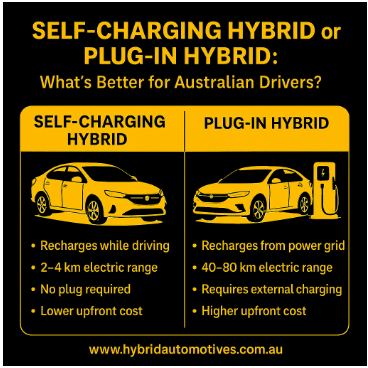
Hybrid cars are becoming increasingly popular in Australia as fuel prices rise and more drivers look for eco-friendly transport options. But when it comes to choosing between a self-charging hybrid and a plug-in hybrid (PHEV), many drivers aren’t sure which is the better fit for their lifestyle. Understanding Hybrid Car Types What is a Self-Charging Hybrid? A self-charging hybrid combines a petrol engine with an electric motor and a small battery pack. It automatically recharges while you drive using regenerative braking and the engine’s power. There’s no need for external charging, making it simple for drivers who live in apartments or lack charging facilities. Popular models in Australia: Toyota Corolla Hybrid, Toyota Camry Hybrid,Lexus NX 300h. What is a Plug-In Hybrid (PHEV)? A plug-in hybrid also uses a petrol engine and electric motor, but it comes with a larger battery that you can recharge via a home EV charger or a public charging station. This allows 40–80 km of all-electric driving before the petrol engine kicks in. Popular models in Australia: Mitsubishi Outlander PHEV, Volvo XC60 Recharge, MG HS PHEV. Key Differences for Australian Drivers Feature Self-Charging Hybrid Plug-In Hybrid Electric Range 2–4 km 40–80 km Battery Size 1–2 kWh 8–15 kWh Charging Automatic while driving Requires external charging Fuel Economy 4–6 L/100km 1.5–3 L/100km (if charged) Price Range (AUD) $30k–$50k $45k–$80k Battery Size & Driving Range Self-charging hybrids have smaller batteries and limited electric-only range. PHEVs can handle most daily commutes on electricity alone if charged regularly. Charging Methods Self-charging: No plug needed — recharges while driving. Plug-in: Needs a charging point. Public EV infrastructure is expanding in Sydney, Melbourne, Brisbane, and Perth. Home charging installation costs around $1,000–$2,000 in Australia. Fuel Efficiency & Running Costs In stop-start traffic, self-charging hybrids perform well thanks to regenerative braking. PHEVs can achieve extremely low fuel use (as little as 1.5 L/100km) if you mostly drive in EV mode. Purchase Price & Incentives PHEVs are more expensive upfront but may qualify for EV rebates and stamp duty concessions in certain states. Self-charging hybrids are more affordable and don’t rely on charging access. Maintenance & Reliability Both types require similar servicing schedules, but PHEVs have larger batteries which may increase long-term replacement costs. Hybrid battery warranties in Australia often range from 5–10 years. Pros and Cons for Australian Drivers Self-Charging Hybrid Pros No charging infrastructure needed. Lower initial cost. Simple ownership experience. Cons: Short electric-only range. Slightly higher fuel use compared to charged PHEVs. Plug-In Hybrid Pros Long EV range for daily driving. Significant fuel savings if charged regularly. Eligible for government incentives in some states. Cons: Higher purchase price. Requires charging access. Which is Better for Australian Conditions? Best for City Drivers Self-charging hybrids work well in urban traffic, where regenerative braking captures the most energy. Best for Regional & Long-Distance Drivers PHEVs excel for those who can charge at home and want to drive electric during the week but still have petrol for long trips. Charging Infrastructure in Australia Public charging points are growing fast in major cities and along highways. Regional areas still have limited coverage, so drivers outside metro areas may prefer self-charging hybrids. Cost of Ownership Comparison Feature Self-Charging Hybrid Plug-In Hybrid Purchase Price $30k–$50k $45k–$80k Annual Fuel Cost (avg.) $1,000–$1,400 $300–$800 (if charged) Battery Warranty 5–10 years 5–10 years Servicing Cost Similar to petrol cars Slightly higher for PHEVs
Is a Hybrid Car Worth It in Australia? Pros, Cons & Costs Explained

With rising fuel prices, increased environmental awareness, and a growing range of vehicle choices, many Australians are asking the same question: “Is it worth buying a hybrid car?” The short answer is yes, a hybrid car can be a smart investment for many Australians—especially urban drivers. However, the decision depends on factors like your budget, driving habits, location, and long-term expectations. In this guide, we’ll explore the pros, cons, and real costs of hybrid vehicle ownership in Australia to help you decide if it’s the right move for you. What Is a Hybrid Car and How Does It Work? A hybrid vehicle uses a combination of a petrol engine and an electric motor to power the vehicle. This system enables the car to: Use the electric motor during low-speed or stop-start driving Switch to the petrol engine at higher speeds or under heavy load Charge its battery using regenerative braking and the petrol engine 🔧 Types of Hybrid Vehicles: Full Hybrid (HEV) – e.g., Toyota Prius, Camry Hybrid Plug-in Hybrid (PHEV) – e.g., Mitsubishi Outlander PHEV Mild Hybrid – offers electric assist but not full EV driving Pros of Buying a Hybrid Car in Australia 1. Fuel Savings Hybrids can reduce your fuel consumption by 20–40% compared to traditional petrol vehicles, especially in stop-start traffic. Example: Toyota Corolla Petrol – 6.0 L/100km vs Corolla Hybrid – 4.2 L/100km 2. Lower Emissions Hybrid cars emit fewer greenhouse gases, making them a better choice for urban drivers and eco-conscious consumers. 3. Government Incentives While most EV rebates apply to full electrics, some Australian states offer toll discounts or green vehicle registration benefits for hybrids and PHEVs. 4. Higher Resale Value Due to rising fuel prices and demand for fuel-efficient vehicles, hybrid models generally retain their value better in the used market. 5. Smoother, Quieter Drive The transition between electric and petrol power is seamless, providing a calm and smooth ride—ideal for city conditions. Cons of Buying a Hybrid Car in Australia 1. Higher Upfront Cost Hybrids usually cost $2,000–$4,000 more than their petrol counterparts. 2. Battery Replacement Costs Although rare within warranty periods, hybrid battery replacement can cost $2,000–$5,000 if needed after 8–10 years. 3. Not Ideal for Towing or Off-Roading Hybrids typically have lower torque and aren’t designed for heavy-duty use, making them less suited for rural or rugged Australian terrain. 4. Complex Technology While generally reliable, repairs and servicing may cost more if something goes wrong outside warranty. Cost Breakdown: Hybrid vs Petrol in Australia Category Petrol Car Hybrid Car EV Initial Purchase Price Lower Medium Higher Fuel Cost (10,000km) ~$1,800 ~$1,200 ~$400 Maintenance Cost Moderate Moderate Low Battery Replacement N/A $2K–$5K $7K+ Resale Value Average Higher Unstable Verdict: Over 5–7 years, hybrids often break even or save more depending on driving patterns. Best Hybrid Cars in Australia Toyota Prius – Pioneer in hybrid tech, excellent fuel economy Toyota Camry Hybrid – Midsize comfort and reliability Lexus RX450h / NX300h – Luxury and performance in a hybrid SUV Honda Accord Hybrid – Premium interior and strong efficiency Hyundai Ioniq Hybrid – Affordable and feature-packed Mitsubishi Outlander PHEV – Ideal for families needing electric + petrol flexibility Hybrid vs Petrol: Which Is Right for You? Go for a Hybrid If: You drive frequently in city traffic or do regular commuting You plan to keep the car for 5+ years You’re focused on reducing emissions and fuel costs You value resale value and smoother driving experience Stick to Petrol If: You mostly drive long highway distances in rural areas You’re on a tight upfront budget You require towing capacity or off-road use You plan to sell within 2–3 years What to Expect as a Hybrid Owner in Australia Warranty: Hybrid batteries often come with 8–10 years of warranty Servicing: Similar to petrol cars; major service every 12 months Fuel type: Regular unleaded petrol is usually sufficient Insurance: Slightly higher premiums due to vehicle value
How to Fix ‘Hybrid System Warning – Stop the Vehicle in a Safe Place’
Hybrid vehicles offer impressive fuel efficiency and lower emissions, but like any high-tech system, they can encounter issues. One alarming error drivers sometimes face is the “Hybrid System Warning – Stop the Vehicle in a Safe Place.” This warning is serious and requires immediate attention to prevent further damage or breakdown. In this guide, you’ll learn what this warning means, what causes it, how to respond safely, and how to fix the issue—whether you’re driving a Toyota Prius, Lexus RX450h, Camry Hybrid, or other hybrid model. What Does ‘Hybrid System Warning – Stop the Vehicle in a Safe Place’ Mean? This message indicates a critical issue within your hybrid powertrain, often involving the battery, inverter, or high-voltage system. It warns that continued driving may damage the vehicle or lead to it stalling. Common Causes: Hybrid battery degradation or cell imbalance Inverter or converter malfunction Overheating due to cooling system failure (inverter coolant) Faulty sensors (voltage sensor, current sensor, etc.) 12V battery problems Software glitches or communication errors in the ECU or CAN network What Happens If You Ignore It? The vehicle may stall or go into limp mode You risk damaging expensive components like the inverter or battery It could compromise your safety on highways Immediate Steps to Take When You See the Warning Step-by-Step Guide: Pull over immediately to a safe area off the road. Activate your hazard lights. Turn off the vehicle completely and let it rest for a few minutes. Restart the engine to check if the error persists. Document any dashboard lights or use a scanner to read DTC codes. Safety Tips: Avoid sudden braking unless necessary. Do not continue long-distance driving with the warning. Park in a well-lit area if driving at night. How to Diagnose the Hybrid System Warning Using an OBD2 Scanner or Toyota Techstream: If you own a scanner, plug it into the OBD-II port and read the error codes. Common hybrid-related codes include: Code Meaning P0A80 Replace Hybrid Battery P3000 HV Battery Malfunction C1259 HV System Regenerative Fault P0A93 Inverter Cooling System Issue Visual Checks You Can Perform: Loud fan noise from the hybrid battery Battery charge level fluctuating abnormally Engine struggling to start or switch between EV and ICE Fixes for Hybrid System Warning Basic Fixes (If It’s a Temporary Glitch): 12V battery reset (disconnect and reconnect negative terminal) Software update at a certified hybrid repair center Sensor replacement, especially if diagnostics show voltage imbalance Professional Repairs (If the Issue Persists): Hybrid battery replacement or reconditioning Inverter replacement Replacing cooling pumps or checking fluid levels Wiring harness or ECU repairs Note: Only a certified hybrid technician should work on high-voltage systems. When to Call a Professional Mechanic Call a hybrid specialist immediately if: You receive multiple warning lights (ABS, VSC, Check Engine) The car enters limp mode and won’t accelerate The 12V reset doesn’t clear the warning Estimated Repair Costs: Component Approx. Cost (AUD) Rebuilt Hybrid Battery $1,750 – $3,000 Inverter Replacement $2,000 – $5,000 Sensor Replacement $250 – $600 Diagnostic Scan $100 – $250 How to Prevent Future Hybrid System Warnings Get regular hybrid battery health checks Flush and refill inverter coolant as per service schedule Use OEM-certified parts during repairs Avoid prolonged inactivity or deep discharges of the HV battery Common Hybrid Models Affected These models often experience this warning: Toyota Prius Toyota Camry Hybrid Lexus CT200h Lexus RX400h / RX450h Lexus NX300h
Toyota Hybrid Battery Warranty: Duration, Coverage & What’s Excluded
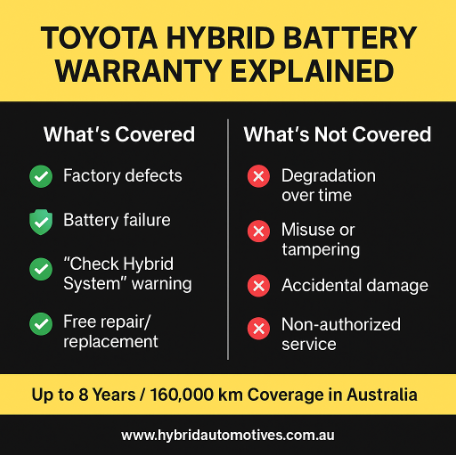
If you own or are considering buying a Toyota hybrid vehicle, one of the most important questions you might ask is: “Is the hybrid battery covered under Toyota’s warranty?” The good news is: yes, Toyota offers comprehensive warranty coverage for its hybrid battery systems. However, the duration, conditions, and limitations vary depending on your region and model year. Does Toyota Warranty Cover Hybrid Batteries? Yes, Toyota offers factory warranty coverage for hybrid batteries across all its hybrid models, including: Toyota Prius Toyota Camry Hybrid Toyota RAV4 Hybrid Toyota Corolla Hybrid Toyota Yaris Cross Hybrid Toyota Kluger Hybrid This coverage is designed to protect against defects in materials or workmanship in the hybrid battery system. Toyota Hybrid Battery Warranty Duration by Model Year The duration of coverage depends on when your vehicle was manufactured and where you are located. Warranty Coverage (Australia): Model Year Coverage Duration Mileage Limit 2020 and newer 8 years 160,000 km 2019 and older 5 years 100,000 km 📝 Note: In the U.S., hybrid battery coverage is up to 10 years / 150,000 miles in CARB-compliant states. In the UK, you can extend coverage up to 15 years with regular hybrid battery checks. What Does the Toyota Hybrid Battery Warranty Cover? Under standard Toyota warranty policies, the hybrid battery is covered for: Manufacturing defects Complete battery failure Malfunctions that trigger warning lights like “Check Hybrid System” Replacement or repair using genuine Toyota hybrid components Repairs or replacements under warranty are typically performed free of charge at authorized Toyota service centers. What’s Not Covered: Warranty Exclusions Like all warranties, Toyota’s hybrid battery coverage has specific limitations. The following are not covered: Normal battery degradation over time Misuse or negligence (e.g., deep discharge from leaving lights on for days) Non-Toyota or unlicensed repairs or modifications Damage due to accidents, floods, or environmental causes Commercial misuse (e.g., rideshare, delivery fleets – check regional terms) How to Check If Your Toyota Hybrid Battery Is Still Under Warranty Here are 3 easy ways to find out if your hybrid battery is still covered: Contact your Toyota dealership with your VIN (Vehicle Identification Number) Use the Toyota Owner’s App or Portal to access warranty records Check your logbook/service history for the date of first registration and battery health check reports Can You Extend Your Toyota Hybrid Battery Warranty? Yes — Toyota and authorized dealerships offer extended warranty programs, depending on the country. Examples of Extended Coverage: UK: Up to 15 years with annual Hybrid Health Checks Australia: Options available through Toyota Extra Care or vehicle service packs USA: Hybrid warranty extension plans through ToyotaCare or third-party providers Be sure to verify terms and conditions, especially for used Toyota hybrids. What If My Battery Fails After Warranty? If your hybrid battery fails outside the warranty window: Options Available: Genuine Toyota Hybrid Battery Replacement: Often $3,000–$5,000 AUD Rebuilt or remanufactured batteries: ~$1,500–$3,000 AUD Independent hybrid battery specialists: May offer cost-effective alternatives Trade-in or vehicle upgrade You should also weigh Battery Health Diagnostics before committing to full replacement. How to Extend the Life of Your Toyota Hybrid Battery While Toyota hybrids are built to last, here are a few tips to improve battery longevity: Avoid deep discharges (e.g., don’t leave electronics running when the car is off) Drive regularly to keep the hybrid system balanced Follow scheduled maintenance and perform hybrid battery health checks Use genuine Toyota parts and service providers
When Does a Lexus Hybrid Switch to Gas? Speed, Modes & Driving Factors Explained
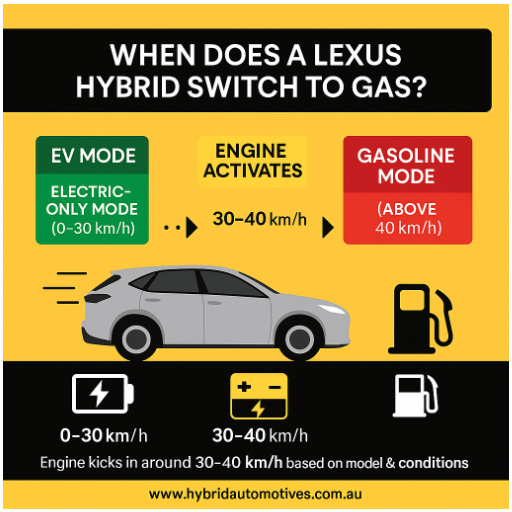
Lexus Hybrid Gas Switch: What Speed Triggers the Engine? Lexus hybrid vehicles are known for blending electric power with gasoline efficiency—but many drivers often ask: “At what speed does a Lexus hybrid switch from electric to gas mode?” Let’s explore how the Lexus Hybrid Drive system works, what speed typically activates the gas engine, and how you can stay in EV mode longer. How Lexus Hybrid Systems Work Lexus Hybrid cars use a system known as Lexus Hybrid Drive, which combines: A high-voltage electric motor A gasoline engine An electronic continuously variable transmission (eCVT) A hybrid battery pack The vehicle can switch between electric-only mode (EV mode), gasoline engine mode, or use both simultaneously, depending on driving conditions. When Does a Lexus Hybrid Switch to Gas Mode? The switch from electric to gas power in a Lexus hybrid typically occurs between 25 km/h to 45 km/h (15 to 28 mph), depending on various factors. 📌 Estimated Engine Kick-In Speeds by Model: Model EV Mode Range Engine Switch Speed Lexus RX 450h Up to ~30 km/h ~35–40 km/h Lexus NX 300h Up to ~25 km/h ~30–35 km/h Lexus ES 300h Up to ~30 km/h ~35–40 km/h Lexus CT 200h Up to ~30 km/h ~35 km/h ⚠️ Note: These figures can vary based on acceleration, terrain, battery level, and climate. What Affects the EV-to-Gas Transition in Lexus Hybrids? Several factors influence when your Lexus switches from electric to gas mode: 1. Throttle Pressure Gentle acceleration extends EV mode. Aggressive pedal input prompts early engine activation. 2. Battery Charge Level A well-charged hybrid battery allows for longer electric-only driving. Low battery levels cause the engine to engage sooner. 3. Driving Conditions Uphill climbs or high-speed roads require more power, activating the gas engine. Urban stop-and-go traffic often allows more time in EV mode. 4. Engine Warm-Up On a cold start, the engine may run to warm itself before EV mode becomes available. Can You Stay in EV Mode Longer? Yes, with proper driving habits, you can extend electric-only operation. Here’s how: ✅ Tips to Prolong EV Mode Driving: Accelerate gradually Drive below 30 km/h (ideal for parking lots, school zones) Avoid steep inclines Use Eco Mode or EV Mode button (if equipped) Keep your hybrid battery charged through regular regenerative braking 💡 Some Lexus models allow manual EV Mode activation, giving you limited electric-only driving under specific conditions. Lexus Hybrid Drive Modes Explained Mode Function Impact on Engine EV Mode Uses only the electric motor at low speeds Delays engine start ECO Mode Optimizes throttle response and AC for fuel economy Reduces engine engagement frequency Normal Mode Balanced driving Standard hybrid behavior Sport Mode Boosts throttle and acceleration Engine engages more quickly Use ECO or EV mode for extended electric driving, especially in traffic or around town.
Does a Hybrid Car Charge Itself While Driving? The Truth Explained
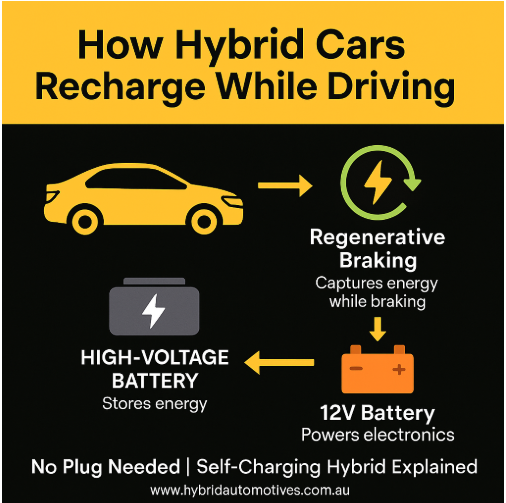
Hybrid vehicles have become increasingly popular for their fuel efficiency, lower emissions, and smart energy usage. One of the most frequently asked questions by new or prospective hybrid car owners is: “Does a hybrid car charge itself while driving?” The short answer is yes—but let’s explore how, when, and what systems are involved. 🚘 What Makes a Hybrid Car Different from an EV? Before diving into how hybrids charge, it’s important to understand how they differ from fully electric vehicles (EVs): Hybrid cars combine a gasoline engine with one or more electric motors and a battery pack. EVs run solely on electric power and must be plugged in to charge. Hybrid cars, particularly self-charging hybrids (like the Toyota Prius), can recharge themselves while driving—unlike EVs that rely entirely on external charging. 🔋 How Do Hybrid Cars Recharge Their Batteries? Hybrid vehicles use a combination of technologies to recharge the battery system without needing to plug in. ✅ 1. Regenerative Braking When you brake or coast in a hybrid, the vehicle captures the kinetic energy that would otherwise be lost as heat. This energy is converted into electrical energy and sent back to the hybrid battery. ⚡ Think of it as the car “recycling” energy every time you slow down. ✅ 2. Engine-Assisted Charging When driving at higher speeds or when the battery charge drops, the gasoline engine can also recharge the hybrid battery using a generator or DC-DC converter system. This ensures the battery stays charged during extended drives or when regenerative braking is minimal. 🔄 Do All Hybrid Cars Charge Themselves? Not all hybrids function exactly the same way. Types of Hybrids: Hybrid Type Plug-In Required? Charges While Driving? Self-Charging Hybrid ❌ ✅ Plug-In Hybrid (PHEV) ✅ ✅ (but limited) Mild Hybrid ❌ ✅ (minor assistance) Self-charging hybrids (e.g., Toyota Corolla Hybrid, Lexus NX300h) are the most common. Plug-in hybrids (e.g., Toyota Prius Prime, Hyundai Ioniq PHEV) require external charging to utilize their larger battery packs. Mild hybrids assist with fuel economy but do not offer full electric drive modes. What Happens to Charging at Idle or in Traffic? In traffic or at idle: The engine may start and stop automatically to save fuel. Regenerative braking is still active during frequent stop-and-go. The system continues monitoring and adjusting energy flow to keep the 12V battery and HV battery at optimal levels. Common Myths About Self-Charging Hybrids Myth: Self-Charging Hybrids Are Always Fully Charged Fact: These vehicles do not achieve 100% battery charge during driving; they maintain an optimal operating range, not full capacity. Myth: Hybrids Can Drive Forever Without Charging Fact: Hybrid batteries deplete and recharge constantly during operation. Without braking or engine running, they will eventually drain. Myth: Plug-in Hybrids Can Always Self-Charge Fact: PHEVs can only partially charge themselves. For full electric range, plugging in is required. Plug-In Hybrids vs. Self-Charging Hybrids: Which Is Better? Feature Self-Charging Hybrid Plug-In Hybrid Plug-In Required ❌ ✅ EV Driving Range Low (~2–3 km) High (30–80+ km) Battery Size Small Large Regenerative Braking ✅ ✅ Ideal For Daily city driving Mixed/hybrid EV usage Both options suit different driving styles. If you drive short distances and want to avoid plugging in, go self-charging. For longer EV-only commutes, choose a plug-in hybrid.
What Powers the 12V Battery in Hybrid Cars If There’s No Alternator?
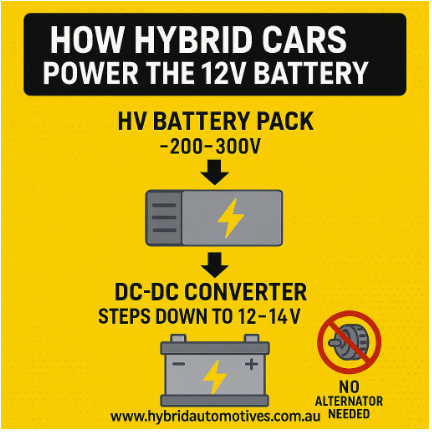
Hybrid vehicles are known for their fuel efficiency and advanced technology, but many drivers are surprised to learn that most hybrid cars don’t have a traditional alternator. This raises a common question: How do hybrid cars charge their 12V battery without an alternator? Let’s break down how the electrical system in a hybrid vehicle works and what powers the 12V battery. Do Hybrid Cars Have Alternators? No — most hybrid cars do not use traditional alternators. In conventional petrol or diesel cars, an alternator is powered by the engine’s serpentine belt and converts mechanical energy into electricity to charge the 12V battery. However, hybrids are built differently. Since the gasoline engine doesn’t run continuously, especially at low speeds or during electric-only driving, relying on an alternator would be unreliable. Instead, hybrids use a DC-DC converter as part of their electrical system. How Does a Hybrid Car Charge the 12V Battery? In hybrid cars, the 12V battery is charged by a DC-DC converter, which draws power from the high-voltage hybrid battery pack (usually 200–300V) and converts it to around 12–14V to charge the low-voltage system. ✅ Key Functions of the DC-DC Converter: Converts high-voltage DC to low-voltage DC Keeps the 12V battery charged at all times Powers the car’s accessories (lights, radio, sensors, etc.) Eliminates the need for a mechanical alternator This system ensures your car’s 12V electronics function properly even when the engine is off, as long as there’s charge in the main hybrid battery. Role of Regenerative Braking in Power Management Another advanced feature in hybrids is regenerative braking, which converts kinetic energy into electrical energy during braking. This energy goes to the high-voltage battery and indirectly supports the 12V system via the DC-DC converter. This process improves overall efficiency and reduces wear on traditional braking components. DC-DC Converter vs. Alternator: What’s the Difference? Feature Alternator (Gas Cars) DC-DC Converter (Hybrids) Power Source Engine belt Hybrid battery Output Voltage ~12–14V DC ~12–14V DC Works When Engine Off ❌ ✅ Maintenance Needed Belt wear, bearings Low maintenance Efficiency Moderate High The DC-DC converter is a more reliable and energy-efficient component compared to an alternator, especially in stop-start or all-electric driving situations. Common 12V Battery Issues in Hybrids Even without an alternator, hybrid 12V batteries can still experience issues. Here are a few signs of a weak 12V battery in a hybrid: “Check Hybrid System” warning Difficulty starting the car Unresponsive infotainment or dash lights Trouble locking/unlocking with remote These symptoms may be misdiagnosed as alternator failure — but in a hybrid, it’s often a faulty 12V battery or DC-DC converter. Do Plug-In Hybrids and EVs Use the Same 12V Charging Method? Yes, most plug-in hybrids (PHEVs) and fully electric vehicles (EVs) also use a DC-DC converter. Since these vehicles lack a gasoline engine entirely (in EVs), they rely exclusively on high-voltage batteries to support all systems, including the 12V system. Examples: Toyota Prius/Prius Prime Tesla Model 3/Y Hyundai Ioniq Hybrid/EV All use DC-DC converters — not alternators.